The New Industrial Revolution: Energy Impact Partners and Meeting Demand at the Grid Edge
Energy Impact Partners LP is working with EEI member companies to navigate a new industrial revolution and build out a clean energy future. EEI thanks EIP for being a sponsor of EEI 2024.
Automation, artificial intelligence (AI), and an explosion of data generated by smart and interconnected technologies of all shapes and sizes have propelled the world into a new industrial revolution. And, just as previous revolutions created and reshaped entire industries, the world already is seeing the transformative potential of the data-driven, digital-centric revolution of the 21st century.
The trajectory of this revolution hinges largely on the electric power industry’s ability to meet once-in-a-generation demand growth as data centers crop up all over the country and transportation electrification, industrialization, and reshoring of manufacturing continue to accelerate.
After years of flat demand for electricity, the Federal Energy Regulatory Commission (FERC) recently reported that grid operators project demand growth of 4.7 percent over the next five years—up from a previous estimate of just 2.6 percent. Grid planners are bracing for peak demand growth of up to 38 gigawatts (GW) by 2028. And, that may only scratch the surface of demand needs over the next several years as energy-hungry data centers continue to come online.
Data center demand projections vary, though there is consensus among experts that these facilities and the advanced AI and computing technologies that they support will be a key driver of demand growth. Consider a recent analysis from McKinsey & Company projecting an additional 50 GW of generating capacity will be needed to meet the electricity needs of data centers in the United States by 2030. By the end of the decade, the global consulting firm projects data center electricity demand will increase by 400 terawatt-hours—or nearly a tenth of U.S. energy consumption in 2023 alone.
“We truly have entered a new era of electric power demand growth, with the potential for the industry to double or triple the amount of power it provides today while continuing ongoing decarbonization efforts,” says Jake Elder, senior vice president for built environment at Energy Impact Partners LP (EIP). “We have been having a lot of conversations with our strategic partners, including with investor-owned electric companies, about how to thread this needle while harnessing this generational opportunity to modernize the grid while maintaining safety, affordability, and reliability.”
“We truly have entered a new era of electric power demand growth, with the potential for the industry to double or triple the amount of power it provides today…”
Founded in 2015, EIP is a global investment firm with a portfolio that includes dozens of companies working to reduce global carbon emissions and pave the way toward a resilient clean energy future. With more than $4.5 billion in assets under management, EIP works directly with EEI and its member companies—including Ameren, FirstEnergy, Southern Company, Xcel Energy, and more—on everything from carbon-free energy generation, microgrids, and long-duration energy storage (LDES) technologies.
Elder says the industry will need to pursue a variety of solutions for meeting projected demand, including future-proofed gas generation and a bundle of carbon-free generation such as nuclear energy, hydropower, wind, and solar energy. Noting the “gauntlet” that the industry faces as it leads carbon-reduction efforts while simultaneously working to serve data centers and an increasingly electrified economy, Elder highlights the potential of distributed energy resources (DERs) and
technologies that can be deployed by electric companies at the grid edge.
“One of the themes that we feel has been underappreciated, and understandably so given historical context, has been electric companies’ embrace of customer-sited assets—whether that’s solar and storage, microgrids, or additional peaking capacity that can be deployed at the grid edge,” Elder says. “Our industry partners are figuring out ways to deploy these assets at scale in a way that works with their business model.”
He highlights several benefits, including the ability to circumvent some siting and permitting bottle-necks associated with the construction of larger power plants and traditional generation, transmission, and distribution infrastructure. By working directly with data center developers or other customers willing to host assets onsite, Elder notes that electric companies can mitigate grid strain while meeting demand relatively quickly and cost-effectively.
Bringing an Asset to the Grid
While estimates of future demand vary, the years of relatively static growth appear to be over in the near term. FERC is expecting nearly 5-percent growth by 2028, and the U.S. Energy Information Administration projects the grid will need to effectively double in size by 2050 to meet demand.
“There is a step-change in expectations. The industry hasn’t had to deal with this kind of demand growth for the last couple of decades,” says Allan Schurr, chief commercial officer at Enchanted Rock. “You have data centers, you have reshoring of
manufacturing, electrification of transportation, and all of these other trends that are causing disruption and delays in interconnection.”
Enchanted Rock is an EIP-portfolio company that builds natural gas-powered microgrid systems that enhance reliability without creating a dependence on diesel backup generators. The microgrids can tie their natural gas generators together with other distributed resources, including solar and battery storage, to bolster reliability and resilience—while also providing electric company partners with dispatchable onsite generation that offers incentives to customers for hosting assets that can be used to meet peak demand requirements.
The company worked with Entergy on the development of its Power Through program, which offers customers reduced monthly rates for hosting onsite backup generation. Entergy is able to utilize those assets to support the broader grid when the backup system is not in use.
“Entergy highlights how the regulatory model adapted to this concept. It’s resulted in very cost-effective resilience investments for critical infrastructure along the Gulf Coast and throughout Entergy’s service territory,” Schurr says.
Schurr says data centers are increasingly looking to microgrids as a smarter approach to reliability and that an opportunity exists to develop new partnerships with electric companies. He says Enchanted Rock is working with 15 energy companies,
roughly a third of which is examining microgrid solutions to support their data center customers.
He describes these sorts of partnerships as being appealing to data centers and grid planners alike: Enchanted Rock’s microgrids offer a cost-effective backup generation option for data centers, which have significant reliability and resilience requirements; they mitigate grid strain by adding a dispatchable asset that electric companies can tap during peak hours; and they potentially enable electric companies to meet data center demand requirements relatively quickly and without the need for more costly upstream infrastructure investments.
“There’s often a gap between when data centers want to be online and when generation, transmission, and distribution infrastructure can be built to meet their requirements,” he says. “We can use onsite generating resources to satisfy data center
power needs in the short term as they build out. And, once the necessary infrastructure is in place, we can transition the microgrid to become an asset to the grid.”
Enchanted Rock operates roughly 300 microgrids across the country and is working with Microsoft to support a data center under construction in San Jose, Calif. Schurr says one of the barriers to his company’s work with data centers is access to natural gas and the fact that many facility siting processes have traditionally gnored access to gas in the planning stages. He already sees that dynamic changing as developers begin to proactively work with natural gas companies on siting decisions.
“We believe electric companies can successfully navigate the challenge of load growth and be very attractive to recruiting these kinds of data-center customers in a way that can reduce the impact on rates for their other customers,” he says.
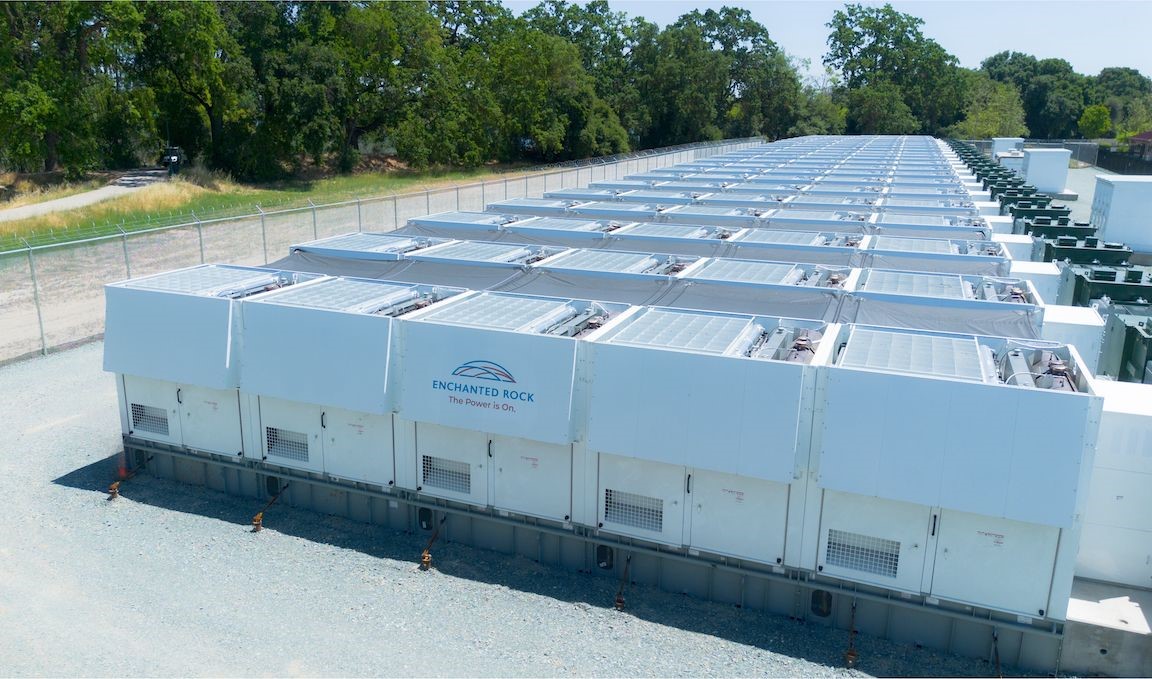
Enchanted Rock's microgrids can serve as backup generation for data centers while supporting the broader grid.
‘Time-to-Power Matters’
Enchanted Rock’s microgrids help manage short-term demand spikes while offering benefits to customers willing to host assets. And, they mitigate, but do not entirely eliminate, the industry’s need to invest in more critical energy infrastructure of all kinds.
Given the scale of investment needed and the relatively short runway to meet projected needs, Pier LaFarge, co-founder and CEO of Sparkfund suggests “it will be easier to build lots of small things quickly—from a siting, permitting, construction, and approval basis—than it would be to build very large assets.” Sparkfund is an EIP-portfolio company that works with electric companies to plan and accelerate DER deployment.
LaFarge says wide-scale DER deployment led by electric companies can mitigate some of the need for large transmission, distribution, or other infrastructure investments; ease overall burden on the grid; and potentially free up grid capacity for incoming data center demand.
“We are in a moment when time-to-power matters,” LaFarge says. “By bringing distributed resources into the core of electric company planning, companies have the opportunity to say where they need distributed capacity most, how that capacity needs to be constructed to create value, and how it can be dispatched in a way that has positive impacts on their otherwise needed infrastructure investments.”
LaFarge notes that DERs have traditionally not been deployed at scale by electric companies—but that he sees an opportunity for companies to take on a more proactive role in deploying customer-sited assets through a distributed capacity procurement (DCP) model.
Sparkfund works with electric companies using this DCP model, helping them develop a plan to purchase and deploy DERs in a way that best and most cost-effectively alleviates grid congestion and capacity challenges and, ultimately, serves customers. LaFarge says the company thinks about buildings as an extension of the grid, and that, despite the upfront cost of DER deployment, strategic investments and placements can mitigate the need for substation or transformer upgrades.
“We are helping electric companies bring solutions tailored to their territories and their customers’ needs as an extension of the utility value proposition and the value of the grid itself,” LaFarge says. “With DCP, you can build 500 kilowatts or 1 megawatt at a time. You can match demand to supply. Regulators like that, because if demand isn’t materializing or if it tails off, you can actually stop a DCP two or three years into deployment. You can’t do that with a lot of other generating assets.”
LaFarge acknowledges the challenges facing the industry: data center- and AI-driven demand, efforts to reduce carbon emissions, and the need to simultaneously move quickly while prioritizing reliability and affordability. Still, he says the industry is staring at a generational opportunity.
“If you can double the capacity of the grid and sell three to four times the amount of electrons over it, the unique regulatory compact of the industry means there are benefits for everyone. You can decrease the cost of energy by selling more electrons and having fixed infrastructure costs spread over more sales,” he says. "DERs can be a key part of achieving that outcome, to the benefit of the grid and electric customers."
The Road Ahead
Already, EEI’s member companies are leading efforts to make the grid smarter, stronger, cleaner, more dynamic, and more secure, investing $1.3 trillion into critical energy infrastructure during the past decade. Just last year, investor-owned electric companies invested $171.9 billion in grid-enhancing projects, with more than $30 billion dedicated to adaptation, hardening, and resilience initiatives to strengthen transmission and distribution infrastructure.
EEI projects the industry’s capital expenditures will total more than $186 billion in 2024, with more than $200 billion invested into the grid in both 2025 and 2026. Those investments are critical to keeping pace with projected data center-driven demand growth, especially considering the rate at which such facilities are coming online.
EIP Senior Partner and Chief Utility Officer Kevin Fitzgerald summed up the industry’s progress: “It’s been satisfying to see our investment thesis that generation would move closer to load becoming more salient by the day as access to power becomes a prized commodity. We’re excited by the industry’s success in leveraging technology to develop and manage capacity on the distribution system, reducing uncertainty and speeding timelines to power."
“We're excited by the industry's success in leveraging technology to develop and manage capacity on the distribution system…”
During a session at CERAWeek earlier this year, Microsoft Executive Vice President Scott Guthrie shared that the company estimated a new data center opens around the world roughly once every three days.
McKinsey & Company estimates data center demand could account for between 30 and 40 percent of all new demand on the grid between now and 2030, when data centers will account for between 11 and 12 percent of total U.S. energy demand.
Still, Elder expresses optimism as he surveys the energy landscape. Technologies like microgrids and strategic DER deployment are helping to support reliability and affordability in the near term. Over the long term, he believes their benefits to the grid will be multiplied when deployed on a larger scale—and that they can help grid planners prepare for and respond to data center expansion and the broader electrification of the economy.
“If navigated correctly, electric companies can deepen partnerships with their customers, help them decarbonize, and grow their business twofold or threefold,” Elder says.