
Alliant Energy and QTS: Powering Growth for Every Customer
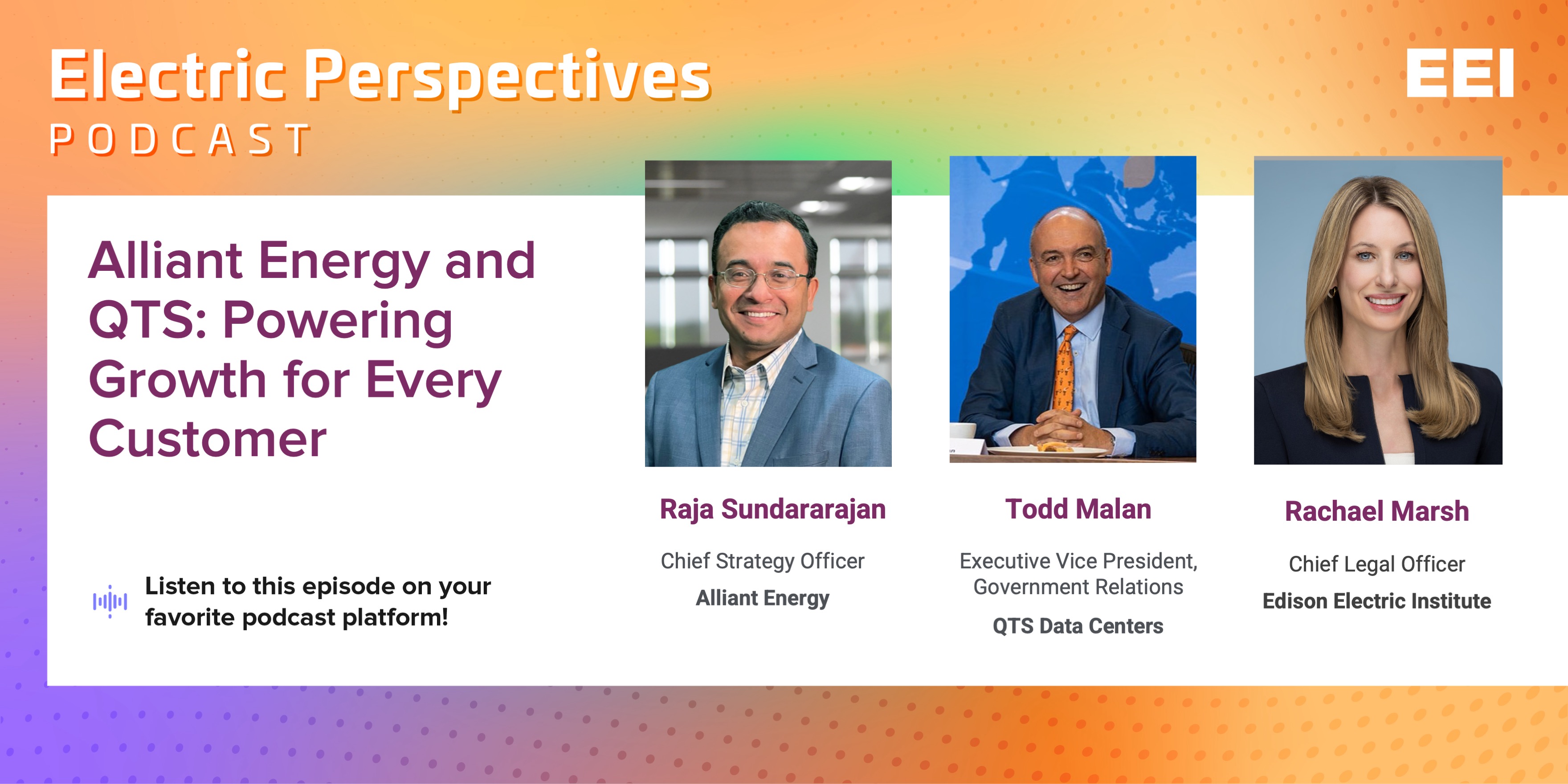
Alliant Energy Chief Strategy Officer Raja Sundararajan and QTS Data Centers Executive Vice President of Government Relations Todd Malan recently joined EEI Chief Legal Officer Rachael Marsh on an episode of the Electric Perspectives podcast to discuss data centers, community engagement, and collaboration between electric companies and hyperscalers.
Following is an abbreviated transcript, lightly edited for length and clarity. To listen to the full episode and catch up with other recent interviews, visit electricperspectives.com/podcast.
Rachael Marsh (RM): Raja, let’s kick off with you. What can you tell us about Alliant Energy’s work with QTS in Iowa? Why was this the right fit for your company and the communities you serve?
Raja Sundararajan (RS): Thanks, Rachael. We serve around a million electric customers and half-a-million gas customers in Iowa and Wisconsin. Our philosophy is to bring on large loads that create “win-win-wins” for our customers. When I say win-win-wins, that’s for existing customers, new customers, and the community that the large load serves.
As part of that, Alliant Energy took the proactive step of investing in land near areas of significant transmission capacity, which we call Big Cedar Industrial Park. That’s where the Cedar Rapids data center that QTS is building is located. This will be the largest economic development project in the history of Iowa.
While we have an obligation to serve, what makes this collaboration successful is the DNA and culture at QTS, where they lead with communities first and are flexible with respect to the timing and issues that require us to serve the large load that QTS has.
The QTS relationship has always been about making growth happen in a way that respects communities and is responsive. That’s the single largest differentiator that we saw with this effort. We have the largest economic development project in Iowa right now, and we have not faced any significant issues with respect to communities. That’s how they do business – effectively investing in large projects while addressing community issues. That speaks volumes of QTS culture and how they serve communities.
RM: Todd, you have many choices and options for where to locate a project. What makes a partner like Alliant Energy attractive?
Todd Malan (TM): QTS has been building data centers and data infrastructure for more than 25 years. We are in a new phase of data infrastructure, where you have these larger campuses for AI workloads.
At the same time, we have built a strong relationship with Alliant Energy. We have an energy partner and a utility partner that believes in the exact same things we do: core principles about how to build capacity and recognize communities. You have to be a good listener, and you need to be able to adjust to what a community’s priorities are. You need to be able to stand in the public square and answer questions and be transparent. That’s a hallmark of how Alliant Energy builds their energy infrastructure, so they have been a good match for how QTS wants to build data infrastructure.
At any given time, QTS has 40,000 contractors at a QTS site. We’re building six large-scale data center campuses in the United States, on top of the 75 that we own and operate now. We’re very aware that there are concerns in communities. It’s really about how you respond to that. That’s a hallmark of Alliant Energy and QTS.
In Cedar Rapids, the other ingredient is we had strong elected leadership in Mayor Tiffany O’Donnell, who sat down with us and said, “Great, you want to build a data center here? Here’s what’s important to Cedar Rapids. These are the things you have to do to be part of our community.” That’s exactly what we want.
Alliant Energy also did the work of finding the land and getting it zoned as industrial land. There was an easier pathway for us to do this in Cedar Rapids.
RM: Raja, when a developer like QTS comes to your service territory and makes such a long-term commitment, how does that affect your company’s long-term planning for the future for all customers?
RS: It obviously requires planning in terms of serving that large load. We have grid investments that need to be made. Fortunately, the land already had transmission access readily available. The biggest component was the generation needed to serve this large load. That’s where we took more of a long-term view. When you have this large load, that allows us to appropriately size the amount of generation. They're paying their fair share for both generation and transmission investments, but, on the other hand, we want to make sure they’re actually providing benefit to existing customers.
That's the key ingredient. We are trying to navigate not just paying their fair share, but also how that can protect existing customers.
We were able to navigate and achieve a five-year “stay out,” or rate freeze. That’s unique, and that’s enabled by the large load that's coming in and providing benefits. That’s the biggest change that you can see, where utilities are navigating these win-win-win scenarios. We are not only trying to make sure that the existing customers are seeing lesser rate increases, but actually, in fact, in our case, no rate increase for five years."
If the large load leaves after 15 or 30 years, that generation can be used to displace other, existing generation assets that would be getting old and would be retired. There are a multitude of benefits that these customers bring in, and that allows us to do more holistic long-term planning.
TM: I’d add that this is a complex area, with some complicated economics in terms of planning, in terms of what would otherwise have been borne by customers in terms of improving infrastructure in the region.
If a large load customer can come in and take down the lion’s share of that cost, what it does is help stabilize rates for all the other customers in that area. That's a fairly complex thing to explain. What I love about what Raja and Alliant Energy President and CEO Lisa Barton were able to do is that, when we made the announcement of this data center, they had a very simple message for customers: These data center investments are going to allow us to keep your rates flat for five years. That was an on-the-record statement right out of the box, and it was a simple reassurance to people. Your rates aren't going up because QTS is here.
There’s an old saying in politics: “If you're explaining, you're losing.” I like how Alliant Energy was able to just cut to the chase and say, "We're guaranteeing your rates won't go up for five years."
RM: I understand Energy Secretary Chris Wright visited to discuss the project and highlight the Ratepayer Protection Pledge, which sounds aligned with everything you all have described. Todd, tell us more about the Ratepayer Protection Pledge and how it connects to your work.
TM: We think that the Ratepayer Protection Pledge is really an important assurance to individual ratepayers that are worried about affordability and energy cost – and rightly so. This historic investment in data infrastructure that we all need for our everyday lives.
By the way, this isn't just for AI. It's for if you use MyChart to schedule your kids' pediatrician appointment, if you are working with your kids' teachers online – that is all running through a data center.
The Ratepayer Protection Pledge is an important way for utilities, the large load data infrastructure, and AI companies to reassure people that we are going to pay for our own additions to energy infrastructure. In fact, we will be picking up the tab that would've normally gone to the other customers.
You're seeing quite a few governors who are putting out guidelines that are saying, “If you're going to build infrastructure in our state, you're going to meet these requirements.” That means transparency about water, or you're going to do a community benefit agreement. And I think that's really healthy – to actually have these elected officials who have to represent their constituents going out there and saying, “Yes, we need this. Yes, we have to stay ahead of China in terms of energy infrastructure and the creation and use of AI, but if you're going to do this in my state, you're going to meet these minimum requirements.”
The Ratepayer Protection Pledge and these other sort of standards and guidelines are important ways for people that have legitimate concerns to feel like they're heard and somebody is doing something about it.
RM: Raja, tell us more about how Alliant Energy structured its agreements to ensure the right balance of protecting reliability and affordability for existing customers while moving with speed to serve QTS and other large loads.
RS: Back in 2023, we were already having conversations with QTS and the Googles of the world that we serve in Cedar Rapids. We told regulators, “If you approve us working with these large loads and serving in a more efficient manner, that will effectively enable us to freeze rates for five years.” That’s what started off this conversation. It was very open and transparent. We showed various forecasting scenarios – what it would mean to bring in 500 megawatts to a gigawatt.
As part of that rate review, we created the ability for agreements to be made with large load customers, in our case, where the commission approves within 90 days. That addresses the speed-to-market issue. As part of the filing, we show revenues coming from large loads more than cover the incremental cost to serve large loads.
You need to effectively make a demonstration to not only our commission, but other key stakeholders like consumer advocates and industrial groups, to show the marginal revenues coming from this customer far exceed the marginal cost to serve them.
We have promised that we will not file a rate case until the end of the decade. To the extent we’re successful with additional opportunities, we might be able to extend our rate freeze. It’s a great way to showcase a win-win-win.
RM: Let’s shift gears: We’ve talked about affordability, but we’re also hearing about the speed part of the equation from data centers. Raja, how do you align that desire to bring projects online quickly given that we’re talking about long-lead-time infrastructure projects?
RS: Speed-to-market is the name of the game, and we have to address customers’ needs. What we have done historically is that developers purchase land in a favorable location to build a data center. Then, they come to us and say, “What will it take to power this data center?”
We have a great relationship with ITC Holdings. ITC has built a lot of transmission over the last decade or so that has enabled us to tap into existing transmission capacity across our footprint. There are pockets where it requires a not-significant transmission upgrade to enable a large load. We direct hyperscalers and developers to these locations to address speed-to-market.
On the generation side, we say, “Can you live with non-firm conditions? Can you live with the ability to curtail under critical times before a gas plant or other resource comes online?” That’s another shift in conversations, where developers and hyperscalers are OK with a bridge period. They’re OK with creative solutions to address speed-to-market. Utility infrastructure can take time to build.
This is where the collaboration and real-time conversation between the utility and developers like QTS effectively enables an objective to be met in a timely manner while making sure we don’t rush the development of generation that has community impacts. There are a lot of things you need to respect and address around public concerns and building generation.
That’s the conversation that allows us to navigate both the speed-to-market issues and the natural timelines of building utility-scale generation. This has been a great collaboration, and it’s a testament to the Cedar Rapids data center and the future data centers that we intend to build with QTS.
TM: There’s tension between speed and making sure you’re doing things the right way. It helps to have partners like Alliant Energy that have done a lot of the work. They’ve worked with the community.
It’s important for us to think about the contrast in China. One of the reasons China has been able to scale up their energy infrastructure and their data center infrastructure so fast, at such scale, is because they don’t have to follow the same rules. It’s basically government fiat that this data center is going to go in here.
RM: What is QTS doing to ensure communities benefit from these projects?
TM: We made a commitment to communities that's pretty holistic across the board. It's up on our website, so we're accountable for the principles that we've laid out there – and it starts with the ratepayer protection type of commitments around energy infrastructure and paying our own way and being transparent about that.
It extends to water and making sure people understand we are committed to using new technology we pioneered in 2018 that utilizes closed loop water systems. We take water into that system, use it, and it can go back into the municipal water system and be treated like any other input from an industrial operation. It’s not a net loss of water for the system in the region.
It extends to community benefit agreements, making sure we’re supporting communities based on listening to them and what they want and need. That may be different in Ohio than it is in Arizona. We’ve tried to learn from our 25-year history. In a lot of communities, QTS is thought of highly, as a good neighbor and a responsible part of the business community. We put a lot of resources and time and effort into listening and learning, taking action against what we’re hearing from the communities that we want to operate in.
RM: We’ve seen some communities really throw open the doors and welcome this infrastructure and investment. We’ve seen others with concerns about transparency, local impacts, energy use. What do you view as best practices for doing community engagement right?
RS: The first thing is to be open and transparent. We need to talk about what we are actually building. This era of non-disclosure agreements and agreements done in secrecy builds a lot of distrust in communities.
Any infrastructure that needs to be built requires a decent amount of public input and public involvement. We need to be open and transparent – and showcase that we have multiple projects to show what this means to a community. There are a lot of misconceptions out there.
We have to be much more proactive and open and transparent in terms of what projects are and how they affect communities. Without that, you quickly lose trust within a community.
We are seeing the economic development benefits of this construction project in Cedar Rapids in real time. You’re talking about 8,000-plus construction workers. You’re talking about meaningful impact to communities, and these are not temporary jobs. A significant amount of permanent jobs are created, also. There are a lot of misconceptions out there that need to be openly promoted and debated. As long as the community makes an informed judgment knowing all the facts, we respect each community’s decisions. I think being open and transparent goes a long way.
TM: The key is starting off with a level of trust and being able and willing to stand in the public square and say, “Here’s who we are. These are our values. This is how we operate. This is what we think could be built in your area that’s going to help society benefit from the tools of the digital economy.”
In Louisa County, Va., earlier this year, they announced that they’re lowering everybody’s property taxes because of data center tax payments in their county. Meta just announced a cool program around training in skilled trades for young people. There are a lot of strong examples around best practices that a lot of different companies are engaged in.
The Electric Perspectives podcast discusses the latest trends and issues shaping the electric power industry. Each episode features an interview with guests including executives from EEI and its member companies, government and industry partners, and energy thought leaders and …