
Podcast: The Lineworkers Behind the Energy of Every Day
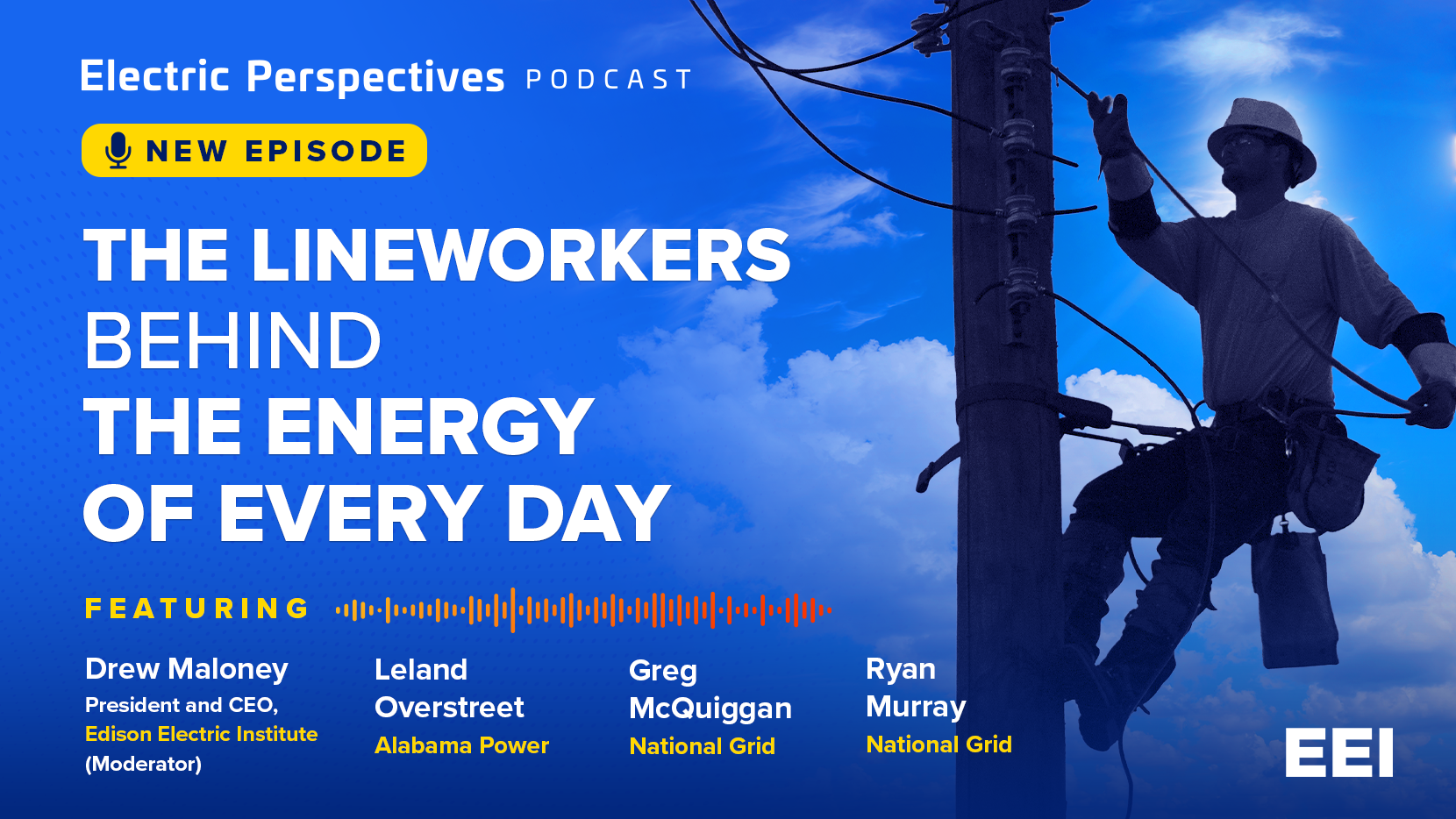
In recognition of National Lineworker Appreciation Day, EEI President and CEO Drew Maloney hosted a recent episode of the Electric Perspectives podcast, joined by lineworkers Greg McQuiggan and Ryan Murray of National Grid and Leland Overstreet of Alabama Power.
Following is an abbreviated transcript, lightly edited for length and clarity. To listen to the full episode and catch up with other recent interviews, visit electricperspectives.com/podcast.
Drew Maloney (DM): How did each of you get started as a lineworker?
Ryan Murray (RM): I had some buddies who got in the field, and I took interest in it. They brought me aside and showed me some stuff. I always wanted to work outside, and I always had interest in electricity.
Greg McQuiggan (GM): I'm third generation. My grandfather was a line mechanic. My father was on the management side of things.
I played sports up until I was 23. And when I was done with that, my grandfather, when I was younger, said, "What are you going to do when you're older?" I said, "I'm going to play sports." He goes, "Yeah, when that doesn't work out, what are you going to do?"
We were standing in his backyard, he pointed up and he goes, "You ever think about working on those?" I didn't pay much attention to it. When sports ended, I signed up for the Southeast Lineman Training Center in Georgia. Went through the Georgia Line School, did a whole bunch of interviews, and, fortunately, ended up at National Grid. This has been my career since.
Previously, I had a bunch of odd jobs trying things out on my dad's side. I knew I couldn't do management stuff. I can't sit in an office. I can't sit still. When I got into other things outside, I really enjoyed it, and this has been an unbelievable profession at this point.
Leland Overstreet (LO): My dad, he worked at Ingles Markets. I think he worked there for 28 years. He just retired last year. He was an electrician. I always thought it was cool – rubbing your socks against a carpet and shocking yourself, you're like, "Hmm, how did that come about? "
At the same time, I thought it was a really good career. I like transmission more than distribution. I just like the bigger stuff. I've seen that they use more equipment and stuff like that.
It has been a really fulfilling job. I enjoy every day of it. When we get to use a dozer or a skid steer or something, mechanized equipment, I feel like a kid again. It's just living a dream.
DM: The culture of safety is so huge for all lineworkers. Leland, how do you keep yourself safe every day, and how do you train newer workers coming onboard?
LO: We follow our procedures and rules and stuff like that. Before we even get to a job site, or when we're at the job site, we'll have a job safety brief. Everybody will have an idea of what they're going to do for that day.
We'll just make sure we're safe, make sure we're just cautious about everything, and make sure, at the end of the day, we're having fun and just getting the work done.
DM: Greg and Ryan, you guys are out in the truck right now. You have a thunderstorm coming in. What does a normal day look like for you all?
GM: Ryan and I are fortunate to work together quite often. Our bosses put together a board with the job description of what we're doing on a specific day. We'll gather up with our crew. We'll go through the job jacket. We'll gather a plan and get material going for the morning.
From there, we'll meet at the job, where we go over a job brief, discuss our job, who's doing aerial work, who's doing groundwork, where our points of protection might be, how we're going to protect ourselves. Then, we'll just go through it. We usually break for lunch sometime around 12:00 or 12:30 and take about a half hour. Then we get back to it. Usually, we'll leave something easy for the end of the day.
RM: It's interesting with this job, because even though we report to the same place every day, every day is unique in its own way. Every job is a little bit different from the day before.
DM: And with storms coming in, you never know. You have to pre-position. You just don't know where you might end up that day, right?
GM: Right. Storms are actually my favorite part of the whole job. I love trouble. I love the storms. I love all that activity with that. That's where you really have to be dialed in, especially with the guys you work with.
The guy who trained me did a really good job always teaching me, do things consistently, do things always the same way, over and over. I'm trying to push that to Ryan as he's coming through, as well.
The storm situations are amazing. Like Ryan said, it could be different. I could go to a broken arm job, cross arm job, run off to go up, and replace something like that. Then the next call could be three sections of primary down, which requires switching to get customers restored before we can fix stuff.
It's actually a lot of fun. The hours start to get aggressive at times, and that's when you really start leaning on the guy you're working with to be a part of your day-to-day, make sure you guys are all on the same page.
DM: For Winter Storm Fern – the big snowstorm and ice storm that I know, Leland, you were involved with –America got to see mutual assistance in action. You had 65,000 line workers from 44 different states help work through that storm. Leland, how did you think about preparing for that storm, and what was involved?
LO: We knew it was icy. It's cold. So we just came up with a good game plan, made sure that we had all the equipment that we needed, because it's really dangerous dealing with winter storms, especially down here in Mobile. That's pretty rare. You have people on the highway slipping and sliding, and you’re trying to avoid them.
We just tried to just make sure we had all of our equipment, made sure that all of our men were pretty well aware and well-equipped for what they’re doing. This is an unusual phenomenon in Mobile, but we just got it done and followed our procedures and safety rules. And we got the lights back on.
DM: Greg, Ryan, I assume that's the same outside of Buffalo. You guys get crushed with snow and all kinds of different types of challenges up there. How often are you called in to help other utilities in the area? How often do you have to travel when you have a major storm challenge?
GM: That's a really cool perk of this job: You do end up in spots throughout New York State. The Northeast, for me, I would never normally go to otherwise. When I first started, I'd say the first 10 years of my career, I was fortunate to go to a bunch of great spots, different locations, and help different utilities. That was cool, because like Ryan said, every day is the same, but not every system's the same. We have different wire sizes, different styles of construction, different ways of doing things. And it's cool to learn as a line mechanic, to make your own style based on everything you can see by going and doing assistance. That's one of my favorite parts of the whole job.
DM: Leland, everything you all do depends on your partner and the rest of the crew. What makes a strong lineworker, team, and crew?
LO: Whenever I think of the team, I think of everyone doing their part. Everyone's in a good mood. Everyone just has a main purpose of getting a job done safely and wanting to come home safely. And it's good when you have a really good group of guys. Everybody understands each other all the time. You can obviously joke and stuff like that, but, at the same time, you can multitask and get the work done way more efficiently.
DM: Greg, Ryan, how do you think about teamwork in your crew?
RM: Communication is one of the biggest things about this job. You got to be able to ask a question and trust the guy, and you got to be able to maybe critique him if he's not doing things safely. At the end of the day, like Leland's spoken to, you want to go home safe. That's the No. 1 goal every day.
GM: It's important, too, that you get to know the guy you work with on a regular basis. I know Ryan's wife, I know his child. I know these things about him. He knows my wife. He knows my children. That gives you an added element of brotherhood and camaraderie, which is massive for me and him.
You can joke around and have a blast. But, at the same time, I can tell him when things go wrong or vice versa. "Hey man, I don't know what you're doing up there with that. What are you doing?" You have to end up having that relationship. That is so important to the everyday activity of this job.
DM: You mentioned brotherhood. You are all in your local IBEW union. How important is that brotherhood to what you all do?
LO: I think it's really important. I just know our IBEW down here in Mobile is really good. They just reached out to me, about two weeks ago, to discuss what's going on with the crew and stuff like that, making sure that everybody's good.
If there's anything that we need, or there’s something that we need to be representative for, they're there in a flash. It's good to have another group of guys that does the same thing that you do every day have your back and understand, knowing where you're coming from, when you get into certain situations.
RM: Yeah, it's cool to have that mutual respect, because, in some way, shape, or form, we all do the same work. Having each other's backs is super important. It helps you day-to-day. We spend so much time together, a lot of times more than with our own families. You have to be there for each other, and that's what it all boils down to.
DM: Leland, what advice would you give to someone interested in lineworking as a career and how impactful this could be to their future?
LO: Make sure you have a can-do attitude. Make sure you come in level-headed. You don’t have to be the other guy’s best friend, but come in and have a passion about what you do.
I like to see the younger guys under me. I'm only 23, but I know a few guys coming under me, and they're in line school like, "I'm having a blast." I'm like, "Well, it gets really fun after the fact, but at the same time, it's just really good."
GM: I'd say come in eyes wide open, ears wide open, and mouth partially shut. I don't mean that in a bad way. If you have a question, obviously ask. It's a harder industry. I'll never deny that, but you can learn a ton. There's some incredible human beings who do this job. It's extremely rewarding in terms of your day-to-day. You get to move, work your body.
And when you're doing those storms, man, watching the lights turn on after you just did incredible amounts of work is insane. I have an awesome story about Christmastime. I was working on Christmas Eve on a broken pole outage. Watching all the lights pop on around everyone's homes was just awesome.
It's an extremely rewarding career. It's physically demanding, for sure. Come ready to learn and work. It's an unbelievable career if you come in with the right mentality.
RM: Try and be better each day. Be better than you were yesterday. Never get complacent. That's one of the most dangerous things you can do here. You can learn from anyone.
DM: You raise a good point. I think we all take for granted that, when we go home and flip the light switch, it always comes on. You guys are the ones responsible for keeping those lights on, and, oftentimes, people don't appreciate all the work that goes into that. As we come up on National Lineworker Appreciation Day, what does appreciation from your communities and your customers mean to each of you personally?
LO: Like Ryan said, it's a really good feeling when the lights come on. It makes me feel good that I'm able to provide a service for my community and be a provider. It’s not like everyone can do this line of work. I'm more than willing to make the sacrifice for my community so they can do their day-to-day activities, they can go to school, go to work. It’s just a really good feeling.
GM: It is a job. I understand my life pushed me in this direction. That's why I'm here. Just remember – when you're sitting at home as a customer, and there’s a thunderstorm, and you're inside with your air conditioning running; or in the middle of winter, when there’s a blizzard and your heat's on and your stove's working and you can eat – that if your power does go out, and you see us or any line mechanic show up, we're probably in our 16th hour, our fourth or fifth day working, and we didn't purposefully decide to come to your house when we did. We aren't purposely delaying. We're working as safe and as fast as we can, so please have a good attitude towards us, because we probably haven't seen our families in four days.
RM: It is a good feeling. You see a lot of different stuff and talk to a lot of different people. I've had people bring us coffee and food, or younger kids will make a card for us, and that just kind of keeps you going during those long days.
DM: I often say to policymakers here in Washington that the most critical engine in America is the electrical grid. When the grid's not working, America's not working. You guys are at the heart of keeping this economy, the local communities, everything going. We really appreciate it and appreciate your time. We wish you all the best and look forward to celebrating National Lineworker Appreciation Day.
The Electric Perspectives podcast discusses the latest trends and issues shaping the electric power industry. Each episode features an interview with guests including executives from EEI and its member companies, government and industry partners, and energy thought leaders and …