
Podcast: New Analysis Finds U.S. Electricity Rates Largely Tracking Inflation
America’s electric companies are focused on providing customers with the energy of every day. They are prioritizing reliability and affordability as they position America to win the AI race and power the jobs, industries, and technologies of tomorrow.
An independent analysis conducted by Charles River Associates (CRA) recently found that average retail electricity rates have largely tracked inflation during the past several years—and that data centers are not driving up rates for customers throughout much of the United States.
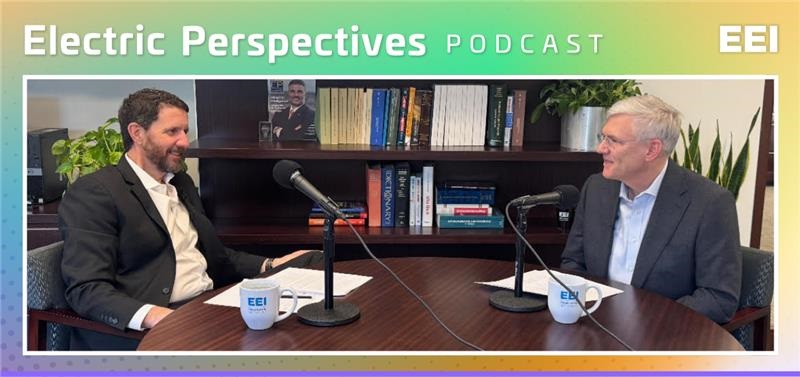
EEI President and CEO Drew Maloney and CRA Energy Practice Vice President Matt DeCourcey joined a recent episode of the Electric Perspectives podcast to discuss the report’s findings, geographic variations, and the role of data centers in America’s energy landscape.
Drew Maloney (DM): I want to start by highlighting one key takeaway: For most U.S. electricity customers, retail rates have generally remained stable and have not outpaced inflation. This new research provides important context for why national average retail rates don't always reflect what customers are seeing at the state level. We're excited to hear more from you today about this, Matt.
EEI's member companies continue to work closely with regulators and policymakers to advocate for policies that keep customer bills as low as possible across the country, and the report highlights that electric companies are doing an effective job managing the cost that they can control.
Matt, can you give us an overview of how Charles River Associates analyzed data for this study?
Matt DeCourcey (MD): We started this process with the idea that we wanted to better understand what's been going on with rates—better understand how that compares to prevailing narratives.
We started with a data set of retail electric rates developed by the Energy Information Administration, giving us national average rates by month for 10 years. We also compiled a whole bunch of state-specific rates, going state-by-state for all the states excluding Alaska and Hawaii and including the District of Columbia.
We also used data from the Federal Energy Regulatory Commission’s Form 1 filing to give us very detailed financial data, including electric company spending on an account-by-account basis with great granularity. Because companies are regulated on a cost-of-service basis, we can understand how their costs are changing and how rates are changing.
We were able to look company-by-company, year-by-year, to see what’s changing, how that correlates with rates, and answers to questions around where things are happening and why.
The national average rate doesn't really reflect reality for most customers. It's sort of the perils of using averages from the conversation you had in your first-year statistics class. We found that there was a small group of companies that had big rate increases. For most companies and most states, the rates weren't increasing. That was an important finding for us.
We found that companies have been managing their costs well—and, in most places, rates have been pretty stable. That's a testament to cost control. It’s the work of the companies, the result of constructive regulation, and the efforts of policy makers in certain states.
We found that data centers—which a lot of people have pointed to as the culprits behind rate increases—haven't really been pushing up rates. With very, very limited exceptions, we found that the rates were going up for specific reasons that we could identify. Those reasons weren’t related to data centers.
DM: What's causing that national average to go up—which is so commonly cited by newspapers and things that we're reading?
MD: It’s rate increases in the small handful of states where rates have been increasing rapidly.
We looked at rate changes over 5 years and 10 years on a state-by-state basis. In California, rates have been going up dramatically in the last five years. That's because of wildfire spending.
In the Northeast, New England, and New York, rates have been going up because wholesale market prices have been going up. The companies buy electricity on behalf of their customers, and they pass that through in the rates. When the wholesale prices go up, the rates go up.
That puts a lot of upward pressure on that national average—just the nature of the arithmetic that goes into it. For most of the other companies and most of the other states, the rate increases had been very moderate.
The average doesn’t represent most of the states and most of the electric companies. In fact, something like 34 states had changes in their rates that were less than the national average. About half of the states saw rates that had gone up consistent with inflation.
We go from this story of broad-based nationwide affordability concerns to one of very local and specific trends.
DM: You mentioned data centers, which have been a very popular theme here in Washington—data centers and the cost associated with powering them. What did you find in your study?
MD: For starters, most data centers that we’re talking about haven't been built yet. When we look back at the history of rates, in most cases, it’s hard to see how they could have increased prices.
It's important to draw the distinction between the AI-training, mega-data centers that are on the horizon and dominating the news nowadays and the data centers that have always been in Northern Virginia for processing credit card payments and things like that. Those mega centers are the ones that we have concerns about causing rates to increase for retail customers across the board. It just hasn't happened yet, because most of them haven't been built yet.
When we look at rates historically, we see rates going up in California and in the Northeast, which is not where many data centers are planning to go. They're going to other places.
There is no evidence to support the idea that data centers have made rates go up. Where the rates are going up is not where the data centers are.
We found that there is this emerging set of principles in regulation and ratemaking that is designed very specifically to prevent rate increases from data centers from happening. The regulators are going about it in lots of different ways. What they're doing is making rates and setting rules that are going to require data centers to pay their own cost of service where electric companies have to make investments to serve data centers. Those costs are going to flow back to the rates to the data centers, and it's going to hold the existing customers harmless.
One interesting development of late has been some hyperscalers coming out and making very specific statements and very specific commitments that they're going to pay for all the costs to serve them. It's the emerging consensus, and a set of best practices is starting to form.
DM: We've seen more than 25 states either enact large load tariffs or consider agreements that will protect customers and enhance the grid over the long term, right?
MD: Yes. When you look at that universe of rate making, all those tariffs look different. There are a handful of mechanisms that are going to make it so that, if a data center wants to connect to the grid, they have to bring the capital and make commitments
And, you're right, there's potential benefits for existing customers. There are investments to be made on the grid. There's also the potential that data centers reduce the cost of retail service for some customers. If you have a new large load customer show up on the grid, and it is paying its own costs, it's going to absorb some of the shared costs. That's going to benefit the customers that are already there.
DM: If you were advising policy makers, regulators, and other decisionmakers on key takeaways from this report, what would they be?
MD: Everything is local.
If you're a policy maker or a regulator considering intervening in a market, understand the problem that you're intervening in and what the solutions would be to consider. If I am in California, and I wanted to intervene in the market, I'd want to think about how we pay for wildfire costs. How do we think about some of the rooftop solar ratemaking concerns that the California Public Utilities Commission has said is also making rates go up for some customers significantly?
If I was in the Northeast, I'd have a very different set of questions. I'd be asking about how we unlatch ourselves from volatile wholesale markets. Do we make investments? Do we change the rules? Do we let electric companies own generation?
Elsewhere, I might wonder whether I have to intervene. Do I have evidence that there is an affordability crisis within my jurisdiction? If so, what do I do about it? There have been rates that have gone up, but, mostly, the markets and the systems have been working as designed in most places.
My other consideration, if I was a policy maker, would be what the industry's responsibility has been. It seems like, in most places, costs are being managed well. We haven't found any evidence to support the idea that the rates are going up because of mismanagement, poor planning, or because of something that should have been foreseen and wasn't.
We don't have any evidence—and, frankly, we don't think it's the case—that companies are profiting from these increases in the rates. The nature of the increases, in most cases, is they're collecting operating expenses that pass directly through to customers at cost. No markup, no profit for the shareholders. They're highly regulated at the state level.
If I was a regulator or a policy maker, I would be very reluctant to do things like curtail returns or anything that would erode the financial integrity of companies and impose penalties. It's just not warranted, and it wouldn't be appropriate.
DM: Let me ask about affordability. You all looked at Americans’ energy wallet and how that's changed over a 20-year period. What did you see in the data?
MD: Generally, the share of the energy wallet has been declining. We looked at how much of your average household budget is consumed by electricity. It’s not a huge band that we’re looking at.
We had a couple decades of data, and it only moves from 1 percent or 2 percent or 3 percent of total household budget. Over time, it is showing a steady decline downwards, which is to say that, over time, less of the average household’s budget is going to electricity.
That’s driven by a lot of things. That’s driven by costs that are fairly stable and by efficiency programs and efficiency of appliances. Society, as a whole, became more efficient over time. The impact on affordability is that, over time, the industry is requiring fewer dollars every month from your average household. It’s less than 2 percent.
DM: How do you differentiate between bills and rates?
MD: We looked at residential rates, because we think those are going to be of greatest interest to most customers and to policymakers. For your average household, it's the residential rate that sets the total cost of energy every month.
When you multiply total usage by the rate, you get the total bill. The bill is a function of both the rate and energy usage, both of which can change over time.
DM: The White House recently announced an agreement with governors that EEI has broadly supported to make changes to the PJM marketplace. What's your view of that announcement?
MD: It's interesting, and we'll be watching it closely to see where it goes. It actually tells us a lot about how we're going to look at data centers entering the market going forward.
It's not clear what comes of the announcement, specifically, but what it does tell us is that policy makers are going to intervene to protect existing customers from the potential of cost increases due to data centers. It’s one of these emerging principles in the industry that, where large loads and data centers are entering the market, they're not going to be subsidized by existing customers.
DM: Do you see companies getting into the generation business in PJM and other regions as one of the possible solutions here?
MD: It could be. One of the things that differentiates the impact of this most recent PJM capacity auction is that they're much more sharply felt in the states where the companies have divested their generation.
Having generation is a natural hedge against variation in the market. That's axiomatic. This is a variation in the market, so if all else is equal, companies that own generation on behalf of their customers would be better insulated from price shocks like this.
The Electric Perspectives podcast discusses the latest trends and issues shaping the electric power industry. Each episode features an interview with guests including executives from EEI and its member companies, government and industry partners, and energy thought leaders and …