
U.S. Reps. Bruce Westerman and Scott Peters on Permitting Reform and Wildfire Mitigation
Permitting reform, energy reliability, and wildfire mitigation are top priorities for Congress and America's electric companies.
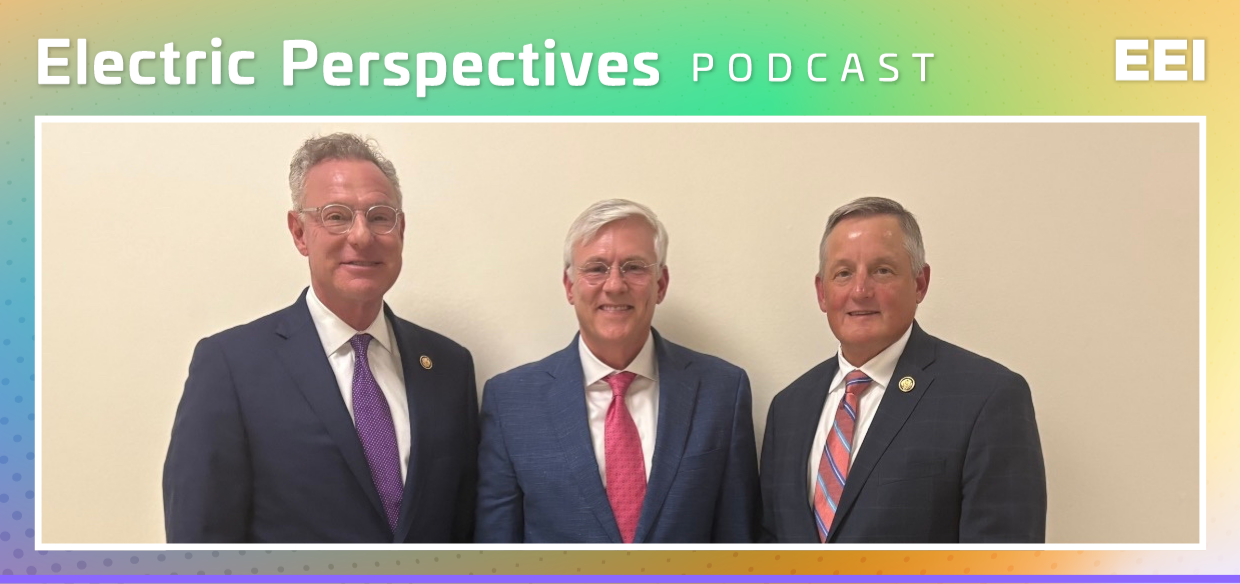
House Natural Resources Committee Chairman Bruce Westerman (R-AR) and Representative Scott Peters (D-CA) recently joined EEI President and CEO Drew Maloney for an episode of the Electric Perspectives podcast. The group discussed America’s energy landscape and the prospects for durable, bipartisan siting and permitting reform—including the Standardizing Permitting and Expediting Economic Development Act (SPEED ACT) and changes to the National Environmental Policy Act (NEPA).
Following is an abbreviated transcript, lightly edited for length and clarity. To listen to the full episode and catch up with other recent interviews, visit electricperspectives.com/podcast.
Drew Maloney (DM): Permitting reform is a big topic for everyone. It takes China one or two years to build a transmission line or new generation, and it can take us in the United States more than a decade to do the same. Chairman Westerman, what can you share about the SPEED Act, your permitting reform efforts, and how important this issue is?
Bruce Westerman (BW): It takes a long time to build things here in America. We have things that we need to build in the energy sector, but also in transportation and infrastructure.
Permitting affects so many different parts of our lives. And, to most people, it's out of sight and out of mind—but it adds cost to things. There’s a way we can do this, keep our environmental standards not only in place, but have even higher environmental standards—and build things again.
That's what the SPEED Act's all about. I'm glad to be leading the charge on it—in the House, at least.
DM: Congressman Peters, you’ve been a big advocate for NEPA reform. Tell us about how this issue fits into the larger permitting reform discussion.
Scott Peters (SP): First, Bruce brought the SPEED Act really far. The thing I give him credit for is that he will listen to folks on the other side to see where we can bridge the gap, where we can bring as many people in as possible. In this context, if you want to get 60 votes in the Senate to get something done that’s durable, it’s got to be bipartisan.
The SPEED Act is a very aggressive reform of NEPA. I think it’s one we need now, and, speaking from an environmental perspective, I see that the market wants to bring on a lot of renewables. We’re looking at an environmental law that’s actually getting in the way of us building renewables. I don’t think that’s what it was intended to do.
Back in the 1970s, the idea was to stop bad things from happening, and NEPA was passed even before the Clean Water Act and Clean Air Act provided substantive protections against the emissions of pollutants into the environment. Today, it’s the most-litigated environmental law. It creates a lot of delays.
Getting NEPA out of the way is really fundamental to environmental protection. It’s hard for folks to let go of it. Modernizing NEPA means building stuff faster. I think people, gradually, on the Democratic side, are starting to understand that, as well.
DM: Mr. Chairman, how optimistic are you that permitting reform can get done this year?
BW: I'm pretty bullish about it, and it really needs to happen this year. It needed to have happened years ago. There was an effort at the end of the last Congress to do some permitting reform, and it just wasn't ready for prime time. I think it's ready for prime time now.
Getting the SPEED Act out of the House was a good milestone. I know the Senate's working on it in a bipartisan fashion. I know the Administration wants permitting reform, and it would be a real shame if we don't deliver for the American people during this Congress.
I wish I had a crystal ball. A reporter asked me the other day if I thought the SPEED Act could ride on the Surface Transportation Bill, which is one of the rumors out there. I said, "I don't know, maybe the Surface Transportation Bill could ride on the SPEED Act, because I've actually got more confidence in the SPEED Act passing than the Surface Transportation Bill right now."
The good thing is there's so much interest in it. People are coming to Washington to talk to their members of Congress like I've never seen before on this issue.
DM: In my role at EEI, I've never seen an effort so involved in trying to get permitting reform done. When it takes you longer than a decade to build a transmission line or a generation facility, that's just unacceptable. Permitting delay costs add about 25 percent onto a project. We can't tolerate that.
BW: Energy is so important—so foundational to our economy—but it affects other things, too. In the reconciliation bill we passed last summer, there was $12 billion in there to upgrade control towers. The Secretary of Transportation told me their problem was they couldn't get through the NEPA reviews to get fiber-optic cables run to control towers. It's just stuff that's nonsensical. We need to put common sense back into the equation and let America build again.
DM: Congressman Peters, we're in this AI data center race while at the same time managing increased electrification, industrialization, and the reshoring of manufacturing activity. How important is permitting reform to those different areas and their connection to reliability and affordability?
SP: I agree with Bruce. This is something that has to happen this year. And we have got all the right players in place. We've got good products in the pipeline. And I heard all these same statistics about how delays cost people money, and every election I've seen has been about affordability. I think that's what people are concerned about. We need to get this done.
We have to do some work on the transmission side, too. To get a bill out of the Senate among Democrats, I think we're going to need some real transmission reforms, and we're having fits and starts in the House. We’re watching the Senate have conversations, and we had the Energy Permitting Reform Act. That was a great start.
It’s going kind of slow over here, but it’s got to happen this year.
DM: We totally agree on that. Chairman Westerman, in Arkansas, Entergy announced a Google data center project that will bring $1.1 billion in net benefits to customers. I know you're very focused on critical mineral production. Talk to us about the significance of that.
BW: We had a recent hearing in the Natural Resources Committee on copper—a whole congressional hearing on copper. It's amazing. Some people say we need to mine more copper between now and 2050 than we've mined in the history of the world. It's a global demand for copper.
Fortunately, we have a lot of copper in the ground here in the United States, but it's not helping us build transmission lines or electrical equipment if we can't get it out of the ground. Mining can take 20 or 30 years to get a permit, and we can't compete in the speed of the global economy if we're waiting 20 or 30 years to mine copper and all the other things that go into computers and electronics.
Arkansas is being pretty aggressive on building new generating power as it's needed—and on recruiting industry and recruiting data centers to the state. What people miss is that, if you're an electric company, a data center is your ideal customer. It's a big, consistent, heavy load that makes your generating equipment operate at a higher utilization rate, which means you can produce electricity at a lower cost for commercial and residential and industrial consumers.
And the data center can actually be a huge benefit to your grid operation and to your reliability and cost structure. I hope all the other states keep saying we don't want data centers and they all come to Arkansas and we're able to take advantage of the benefits of having them there.
DM: The states doing it right on data centers are seeing downward pressure on rates for their customers because of the point you just made. It's a fixed-cost system. If you have a large customer and the state has approved a large load tariff agreement, it's a big win for the grid in the state and the customers.
BW: The other part of that is the data companies are willing to pay for the investments if you need additional generating or transmission capacity. They're even saying they can set their data centers up so, if there's a peak load, they can throttle back their data center so you can meet the demands other places, which helps you even more on the grid.
SP: Right. There's a remarkable consensus that data centers should pay for their costs and assume their risk, because you don't want stranded assets and so forth. They have a lot of money that they're willing to invest. They're talking about how they can actually enhance the grid around a community, because it's in their interest to have that kind of reliability.
The other thing, in California, we notice is that a big part of our rates are the infrastructure that's been built. If you can serve a lot of energy, now you're spreading that cost along fewer and fewer units of energy. If you have more energy on there, more people paying, it actually could have a resulting benefit for customers.
DM: We're going to look back on this period and how we built a much more robust, more resilient grid based on all this data center investment. We're very excited about it. Switching topics, Chairman Westerman, you may be the only forester in Congress. What more needs to be done with forest management as it relates to wildfires?
BW: It's just a matter of doing the right thing. The way Scott and my relationship really started working together on legislation goes out to the Giant Sequoias that only grow in California. There was a two-year period when we lost 20 percent of those trees—the most iconic trees on the planet.
Trees are living history books, because you can go back and measure fire scars, you can count rings. When we had that two-year period, it goes back to the way these groves were being managed. After the gold rush in California, Native Americans quit burning, and we created federal agencies that put all the fires out. You had these slow-growing trees grow up in the understory that would have been taken out by fires that normally occurred every two or three years. They went 120 years without fires.
You had these white fur trees that got up in the lower crowns of the Sequoias. The fire came through, ran up the white fur—which we call it ladder fuel—got in the crown of the Sequoia, and wiped the whole grove out.
Poor Scott went on a CODEL, and I had him cornered on an airplane for hours, pulling out research papers, saying, “Look, this is what the researchers say is happening to the Giant Sequoias.” To his credit, he didn't just brush me off. The next thing you know, we're on a field trip out there looking at these burned up trees. We're working together on a bill called the Save Our Sequoias Act. And when I first got here in 2015, we could barely get any kind of forestry management bill passed out of the House. The Save Our Sequoias Act passed unanimously.
Then we went from there to the Fix Our Forest Act saying, "If this can work for the Sequoias, let's do it on a broad scale." Scott and I worked hours and hours together, and we came up with something we could both agree on.
I say this all the time: There's nothing we can do that's more proactive and better for the environment than to have a healthy forest. If we can't even keep our forest healthy, we've got problems. Our environmental laws aren't about protecting the environment when we can't keep our forests healthy. They're the lungs of the earth, as Teddy Roosevelt said. They're also the kidneys of the earth, because most of the drinking water in this country comes from water that falls on forested land.
I love Roosevelt's language. If you denude the landscape, you're taking everything off the landscape that holds the soil in place. You wash it into the streams, you kill fish, and you ruin our water. There's no downside to having a healthy forest, and that's what we're promoting with the Fix Our Forests Act.
SP: I had a guy from Arkansas who went to the Yale School of Forestry sit down and tell me about the Sequoias, which are my California Sequoias, right? No one from California had the expertise that Bruce had to save these trees. It was ironic, I think, that a lot of the pushback at the beginning came from the environmental communities that seemed more concerned to me at the time about not changing NEPA than they were about saving these iconic trees.
I think they were kind of embarrassed by their response to this, a lot of them, and have been much more constructive and have worked with Bruce and me on how to get this right.
We got overwhelmingly bipartisan vote in the House and this has passed and we're hoping the Senate takes it up soon, because I think it will have support in the Senate as well.
DM: The important thing that both of you all have highlighted is the fact that wildfires are not just a California or West Coast issue anymore. We're seeing wildfires in Georgia and Florida. This is a broader problem that we all need to figure out. How do we get the Fix Our Forests Act to the president's desk?
BW: It has two Democrat co-sponsors in the Senate. It's passed the Senate Agriculture Committee. If you take the two Democrat co-sponsors and the Democrats that voted for it in the Committee, it has the votes to pass the Senate. There's just a lot of cooks in the kitchen, and everybody's wanting to put their final mark on it.
It should have been passed long ago, but we work on it every day trying to get it across the finish line.
SP: I mean, I think the California electric bill is about a third wildfire management. San Diego Gas and Electric (SDG&E) did a lot of innovation around meteorology. They found that there are a lot of reasons why things burn. The benefit to my constituents of the Fixed Our Forest Act, in addition to the general environmental benefits of preserving habitat in the forest, is that the federal government will be doing its part. It will be paying its share and won't be in the way of fixing the forest in California, which is costing so much on our utility bills. I don't think people understand that as well, but that's a really critical cost control thing for us on our electric bills in California.
DM: That’s why we believe it's so critical to get this passed this year and get it to the president's desk. Let me focus on one last point: We all talk about the political division in Washington, but you two are a great example of a partnership that works. You work together on permitting reform. You’re working together on wildfires. How does that partnership work? What lessons can be learned so we can have more of these types of partnerships in Washington?
SP: I like solving big problems. I thought there would be more of that here. I thought that would be the natural thing, but some people are only interested in politics, some people are interested in TV, and some people are scared of their own shadow.
What we've learned is, if you see a big problem, you can follow the facts, you can start with the right answer, and you can build the politics around that. We’ve touched a lot of what people thought were third rails on the left, and there's no third rails. People understand that to solve the problem, you come up with the right answer.
That has not hurt me electorally one bit. People like that I work with the other side. Bruce is conservative. I don't want any Arkansans to think he's some sort of left winger. The thing is, we can agree on this kind of stuff, and he's got expertise that I can use.
I think it's fun to solve big problems. I want these bills to get passed, and I will feel like I have made a contribution as part of my congressional career if we do.
BW: I would agree with what Scott said. I served in the Arkansas legislature for a couple of terms before I came to Congress, and my background is engineering and forestry. I always define an engineer as a glorified problem solver. That's what you learn in engineering schools: how to solve problems.
I'm with Scott. I didn't come here to complain about things or to go on TV and make some point. I want to actually solve problems to make the country better. The way you solve problems is you figure out what the problem is. They teach you in engineering school to find the problem or come up with a plan, do the math, and present the answer. That’s really what you do in Congress. What's the problem? Here's the plan to fix it. Do the work. That last part's the hard part: presenting it and getting people to accept it.
You have to have people that you can work in good faith with that want the same objective. Who wants to see our forest burn down? Deep down, we all want to fix that. Who wants to see it take forever to build things in America, and who wants to see us fall behind China in lots of different areas? I don't think there's many people that fall into that category.
[President Ronald] Reagan said, “If you can get 80 percent of what you want, if you can agree on 80 percent of what's in a bill, you've got a tremendous win.” We live in an instant-information society, where you can find some problem with any kind of solution that's out there, and it's a lot easier to make a lot of noise about what was in the 10 percent or 20 percent that you couldn't get from an idealistic standpoint than to talk about the 80 percent that you get.
The Electric Perspectives podcast discusses the latest trends and issues shaping the electric power industry. Each episode features an interview with guests including executives from EEI and its member companies, government and industry partners, and energy thought leaders and …