
The People Behind the Power: Technology, Teamwork, and Pride in Powering Communities
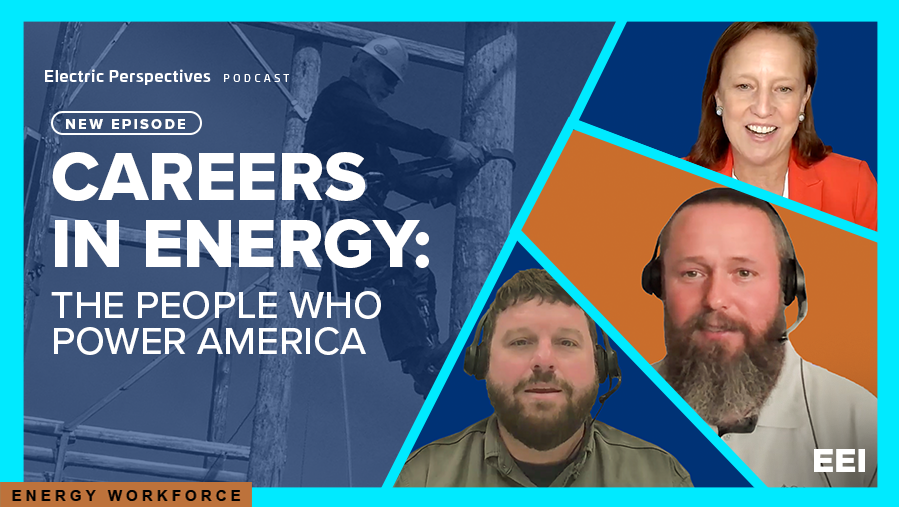
EEI Chief Communications Officer Emily Schillinger joined AES Ohio Electric Line Technician Leader Bryan Woodford and AES Indiana Director of Transmission and Distribution Field Operations Nick Goodman to discuss what brought them to the field, how they're carrying on family legacies, and what it takes to become a lineworker. This episode kicked off Careers in Energy Week on October 19, 2026.
Following is a recap of the conversation. To listen to the full episode and catch up with other recent interviews, visit electricperspectives.com/podcast.
When severe weather strikes, lineworkers know what is at stake: families need to get back to their routines, businesses need to reopen, and communities need to recover.
During Careers in Energy Week, EEI is recognizing the skilled people who keep the lights on and introducing the next generation to the rewarding careers available across the electric power industry.
In the latest episode of Electric Perspectives, Nick Goodman, director of field operations at AES Indiana, and Bryan Woodford, electric line technician leader at AES Ohio, talk about how technology is changing line work, how grid technology has enhanced their work, and what it means to restore power when a community needs help. EEI Chief Communications Officer Emily Schillinger moderated the conversation.
Smarter tools help crews restore power faster
When Woodford started his career as a lineworker more than 18 years ago, many crews still used map books to get from one job to the next. Today, smart meters and automated equipment can help identify an outage, isolate the problem, and get crews moving before a customer calls.
“Our smart meters can let us know about an outage before we ever get the call,” Woodford said. “That way, we can get people en route. We can start troubleshooting. We can figure out what the problem is, and if there is something wrong, we can fix it.”
The changes are just as noticeable in the tools crews carry.
Woodford remembers using large wooden-handled presses to connect wires. Operating them took considerable force, and years of repetitive work could take a toll on a lineworker’s body. Today, crewsuse battery-operated hydraulic presses to do the same work.
“You just reach out and press a button, and it does the same thing, only it doesn’t tear up our body,” he said. “It’s all aimed at working smarter and keeping the customers on longer.”
Goodman, who has spent 28 years in the industry, has also seen technology reshape storm restoration. Automated equipment can isolate a problem and restore service to customers who otherwise might have experienced a sustained outage.
“It really allows us to pinpoint where we’re going to send a crew,” he said. “Now we can kind of laser-focus right to the problem. Restoration times are improving so significantly every single day based on the technology. It’s really amazing to see.”
Goodman added, “It’s an exciting time to be in the industry, to see what’s happening and how well we’re able to turn lights back on.”
“They have your back”
New technology matters, but line work still depends on the people doing it.
Crews work together in difficult conditions, sometimes for long hours and far from home. That creates a level of trust that both Goodman and Woodford say is essential to the job.
“You have to have that relationship with those people, that you have their backs and they have your back,” Goodman said. “You have to be able to look at something and say, ‘Hey, man, I need some help here. I don’t know. I don’t have all the answers.’”
That humility goes hand in hand with constant awareness of what is happening around the crew.
“You have to have your head on a swivel. You have to be looking out for each other,” he said. “That’s one of the greatest things about the industry. You know the people you’re working with have your back, and they’re watching out for you every step.”
Woodford learned the same lesson from his grandfather, who worked as a lineman at AES Ohio for 47 years. They worked together on the same crew for eight of those years.
“My grandpa had a saying that good habits get you through the bad days,” he said. “We talk about being our brother’s keeper, being our sister’s keeper. We’re in this together. We’ve got to get home in the same shape we came in, and we’ve got to look out for each other.”
“We know that our moment’s coming”
Storms put the training, tools, and teamwork to the test.
“These storms, they’re like our game day,” Woodford said. “Our adrenaline gets pumping. We’re ready to get out there and get the customers on.”
Lineworkers often know severe weather is coming and begin preparing before the first call.
“We’re checking the outage map. We’re looking at the weather,” Woodford said. “We know that our moment’s coming, that there’s going to be work to do, there’s going to be people who need our help.”
That responsibility keeps crews moving through long hours and difficult conditions.
“We’re going to keep each other safe. We’re going to take care of each other,” he said. “But we’re going to get the customer on. They’re going to go back to their normal life tomorrow.”
For Goodman, restoring power also brings a deep sense of pride. He remembers traveling through storm-damaged areas in a caravan of line trucks and seeing people cheer as the crews arrived.
“They know what we’re there for. They know what we’re about to do,” he said. “There’s always just a tremendous amount of pride that we feel knowing that those people see us coming and they’re happy to see us.”
The commitment is simple.
“We’re going to help. We’re going to get these lights back on. We’re not leaving until it’s done.”
That moment, when a darkened neighborhood comes back to life, stays with the people who do the work.
“You do some work, you climb some poles, put some wire in the air, replace some poles, and then you drive back around and you turn the lights on,” Goodman said. “They’re cheering that you’ve helped restore that power. It’s really impactful.”
Adapt and overcome
No storm or outage is exactly the same. Crews must adjust as conditions change, solve problems in the field, and work around the clock until the job is complete.
“One of the phrases that a lot of linemen use is ‘adapt and overcome,’” Goodman said. “They’re going to take whatever the challenge is, and they’re going to figure out a way to overcome those challenges.”
Technology helps crews find problems faster. Training and teamwork help them complete the work safely. Pride in serving customers gives the job its purpose.
As Woodford put it, “I like to keep moving. I like to get as many customers on as I can and try to give them a better day.”
The Electric Perspectives podcast discusses the latest trends and issues shaping the electric power industry. Each episode features an interview with guests including executives from EEI and its member companies, government and industry partners, and energy thought leaders and …