
EEI's Rachael Marsh Emphasizes Need for Affordable Electricity and Customer Protections at Data Center Conference
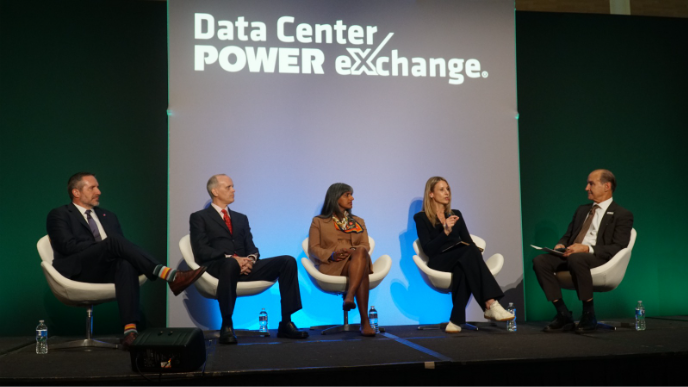
At POWER Magazine's Data Center POWER Exchange in Washington, D.C. on October 1, Edison Electric Institute (EEI) Chief Legal Officer Rachael Marsh emphasized that affordable, reliable electricity must remain central as electricity demand grows.
Marsh joined moderator Mark W. Menezes, president and CEO of the United States Energy Association; Nidhi Thakar, senior vice president for policy at the Corporate Energy Buyers Association (CEBA); Todd Snitchler, president and CEO of the Electric Power Supply Association; and Marcus Nichol, vice president of nuclear deployment and fuel cycle at the Nuclear Energy Institute.
Below are key takeaways from Marsh's remarks:
1.) Affordability and reliability must remain central as electricity demand grows.
Marsh said America's investor-owned electric companies are preparing to meet growing demand by investing in the infrastructure needed to serve all customers.
“Our members are poised to invest $1.3 trillion in the next five years to build the infrastructure we need for the future, and that's because of demand growth,” Marsh said. “For the first two decades of this century, demand growth was essentially flat. We've spent this time talking about AI data centers, but that's just one segment. We're seeing manufacturing growth, electric vehicles, building electrification. There are a bunch of different factors that are contributing to demand growth.”
“Our central focus is on doing that reliably and affordably," she said. "Our members have an obligation to serve all customers, big and small.”
Marsh pointed to EEI's new report, Powering Customer Savings: Helping Residential Customers Save on Energy Costs, which showcases how America's investor-owned electric companies are helping customers through bill assistance, energy-saving programs, and innovative affordability initiatives.
“Electric companies are working every day on customer programs and ways to keep things affordable for families,” she said.
2.) Large customers should pay their fair share, and existing customers should be protected.
Marsh said electric companies are working with state regulators to develop large-load tariffs and other safeguards that ensure new large customers cover the costs associated with serving them.
“What we are focused on is making sure that we can bring on these large loads without shifting costs, making sure that the large customers pay their fair share, and protecting homes and businesses from cost shifts,” Marsh said.
“Those themes are not controversial,” she continued. “New large customers should pay for the infrastructure that they rely on, and that includes the new infrastructure we need to serve them and the existing system.”
As of September 2026, 25 states have approved at least one large-load tariff, and seven states have tariffs pending. These tariffs establish rates, contract terms, and financial commitments that help ensure large customers cover the full cost of serving them.
“Cost-allocation guidelines are pretty well understood. The folks who benefit from infrastructure pay for it," Marsh said. "That's at the heart of these large-load tariffs that states and electric companies are working together to implement.”
“There are differences among regions and states, but there are common throughlines and common tools that have been adopted to make sure that large loads are paying the costs that are appropriate for them and protecting other customers,” Marsh said. "Those include minimum demand charges, exit fees, and financial assurances. These are tools that help make sure all customers are protected.”
3.) A growing body of research shows responsible data center growth can benefit existing customers.
When responsibly connected to the grid, data centers and other large customers can help fund infrastructure that benefits everyone and spread fixed system costs across a broader customer base.
Research from EPRI, Columbia University, and the Brattle Group, shows that responsibly connecting data centers and other large customers to the grid can put downward pressure on rates and benefit existing customers.
Separate analyses from Charles River Associates, Lawrence Berkeley National Laboratory, and the Brattle Group also found that customers outside the PJM Interconnection region have largely been shielded from data center-related cost increases.
“When you have more users on a shared system, it drives down those whole-system costs,” Marsh said. “When we have more people on the bus, the cost of the bus ride is lower for everybody. It makes intuitive sense, and we're seeing the data bear that out.”
“What shouldn't be lost in the conversation is that when large customers connect to the grid in our communities and to our shared system, there can be shared benefits,” she said. “We're focused on that, talking about what we can do as electric companies to protect other customers and the benefits that these projects can bring.”
4.) Building the infrastructure customers need will require a larger skilled workforce.
Marsh called for the energy and technology sectors, manufacturers, organized labor, educators, and government to work together to expand the skilled workforce needed to build, operate, and maintain energy infrastructure.
“This is a place where, as trade associations, we talk constantly about partnerships. This is where the partnerships really have to work,” Marsh said.
“Our members have really strong relationships with organized labor, with workers, and with the building trades, and we think sectors newly trying to build are building those relationships,” she said. "Those relationships are particularly important for the speed-to-power piece, speaking to communities about the business and workforce benefits of these projects.”
“There is an opportunity to use all those partnerships to align our future needs with educational programs. We have partnerships in place with universities, with veterans' programs, and apprenticeship programs,” Marsh said, adding that the industry needs a major, sustained push to align future infrastructure needs with the skilled workforce pipeline.