
Podcast Highlights: Industry Leaders on Building America’s Workforce
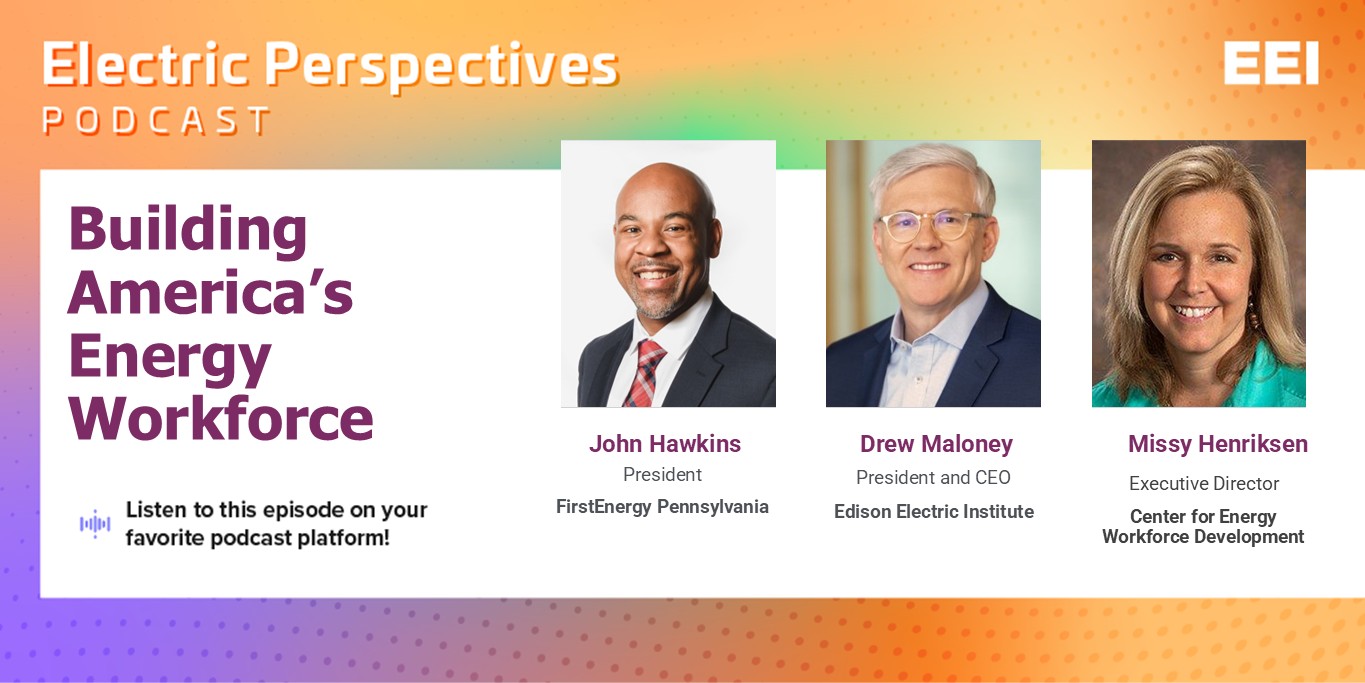
The electric power industry is a key economic driver for the United States, accounting for 1 in 20 American jobs and 5 percent of U.S. GDP. FirstEnergy Pennsylvania President John Hawkins and Centers for Energy Workforce Development Executive Director Missy Henriksen share their thoughts on attracting, retaining, and developing a skilled energy workforce.
The electric power industry is a key economic driver for the United States, accounting for 1 in 20 American jobs and 5 percent of U.S. GDP. Workforce development is a top priority for electric companies as they expand and strengthen the grid and power the jobs and industries of the future.
FirstEnergy Pennsylvania President John Hawkins and Center for Energy Workforce Development (CEWD) Executive Director Missy Henriksen recently joined an episode of the Electric Perspectives podcast to share their thoughts on attracting, retaining, and developing a skilled energy workforce. The episode was hosted by EEI President and CEO Drew Maloney.
Following is an abbreviated transcript, lightly edited for length and clarity. To listen to the full episode and catch up with other recent interviews, visit electricperspectives.com/podcast.
Drew Maloney (DM): Missy, can you give us a snapshot of the current energy workforce and the role that it plays in supporting our economy?
Missy Henriksen (MH): Absolutely. The U.S. Energy and Employment report that the U.S. Department of Energy (DOE) recently published found that there were 8.5 million people working directly in energy jobs in 2024.
We often talk about the electric power industry being 5 percent of the GDP—the first 5 percent, of course, because nothing works without energy. That holds true on the human capital side, as well. We account for 5 percent of the jobs in this country, keeping the lights on and keeping things moving for the nation.
DM: John, you lead one of the largest electric companies in Pennsylvania. What does a highly skilled workforce mean for ensuring reliability and serving your customers?
John Hawkins (JH): Our communities rely on a resilient and reliable electric grid, so we have to have a workforce that has advanced skills and expertise to deliver on those expectations—especially during this period of rapid industry transformation.
At FirstEnergy, we serve 6 million-plus customers in six states. We're investing $28 billion across our footprint through 2029. In Pennsylvania, that includes $15 billion in infrastructure enhancements, people, processes, and facilities—and the key word there is “people.”
We have to have a highly skilled workforce to complete this work safely and efficiently, allowing us to meet those expectations of our customers and communities.
DM: Missy, let me turn back to you. CEWD regularly publishes reports about the energy workforce. What trends are you seeing, and what do they mean for the next generation of energy professionals?
MH: We’re really seeing employers looking at their hiring practices with a great deal of innovation as they think about workforce development differently. It’s no longer, “Hey, HR, we need to hire some people,” but it’s an increasing commitment to the long game and attracting talent.
We’re seeing companies work together more closely in these efforts so that a rising tide will lift all boats. We're seeing, increasingly, a commitment to sector solutions and working together on major workforce opportunities and challenges, instead of every company looking at moving mountains on their own.
About 50 percent of the workforce is expected to retire in the next 5 to 10 years, which is evoking a need to focus on knowledge transfer and making sure we've got a strong talent pipeline to follow those exiting the workforce.
We're also seeing major conversation around the increasing reliance on digital skills and what that means for pre-employment training and upskilling the existing workforce. These are just some of the conversations driving significant industry action.
DM: You also were the former chair of the 21st Century Energy Workforce Advisory Board (EWAB), helping to shape the future energy workforce from the federal level. Can you share more about your work with EWAB and how you worked with DOE on workforce development strategies?
MH: Absolutely. EWAB was formed under the Infrastructure Investment and Jobs Act to advise the U.S. Secretary of Energy on developing a skilled energy workforce to meet current and future labor needs.
We were thrilled to be called on early in the current Administration’s transition to support Energy Secretary Chris Wright and his team with recommendations to develop and implement workforce strategy. We worked really closely with the Office of Energy Jobs within DOE, and they were tremendous thought and action partners in our work.
Our recommendations to Secretary Wright included providing significant support to scale pathways for well-paying, high-quality energy jobs. We focused on new ways to get people into energy roles, including through career and technical education, apprenticeships, and other earn-and-learn models.
The Administration is focusing a lot of emphasis on the importance of registered apprenticeship programs, so we're also making recommendations on the importance of increasing awareness and excitement around energy careers—for career-ready adults and for students.
Also, our recommendations focused on positioning DOE as a leader for innovative, effective, non-siloed solutions to support the development of the workforce as a sector. I think DOE is really making the commitment that they're not just focusing on the technology side of the industry—but, certainly, the people side, as well.
We are thrilled to know that Secretary Wright actually concurred with the overarching recommendations that we put forward. He has committed to developing an energy workforce strategy that enables effective workforce planning and supports the development of a highly skilled workforce. We're excited to see what comes out of that and we're expecting it to be published this fall.
DM: John, coming back to you, FirstEnergy has been recognized for its workforce development and apprenticeship programs, including your Power Systems Institute. Can you tell us how these programs work and what makes them successful?
JH: At FirstEnergy, we are growing and investing in our team, which we know to be the heart of operating a modern grid. We have more than 11,500 FirstEnergy employees dedicated to safety, reliability, and operational excellence.
Through our Power Systems Institute, we've trained nearly 2,600 line and substation workers. This model was unpaid, because we were paying for workers’ education to understand the theory part of the equation. During the summer, enrollees would get paid on-the-job training.
What we found with that model is that it was challenging for some who had families. So, in 2023, we transitioned to a paid apprenticeship model, more in-step with today's competitive labor market. Now, candidates are hired at the onset of the apprenticeship program, so that makes it more accessible to a lot more individuals.
We’re also targeting our hiring to keep workers in areas where they want to be, which helps minimize turnover. We have a lot of opportunities here. Our apprentices can obtain a college degree with financial assistance that we provide. We are working to get our program certified by the Department of Labor, which will make it nationally recognized and increase the appeal to candidates. It will also allow us to access funding and incentives and build union confidence, which is really critical to a successful program.
DM: Missy, CEWD supports programs across the country that help companies replicate successful workforce models like what John’s describing at FirstEnergy. What guidance would you give to electric companies that are working on building their own workforce pipelines?
MH: The first answer would be to call John and his team. You all are doing some incredible work up there. I really appreciate hearing more about the focus you've put on apprenticeships and now DOL-registered apprenticeship programs. I think that will be a game changer as we move forward in the industry.
I also can't stress enough the importance of partnerships. There's a lot of work to be done—a lot of opportunities for the industry to attract a highly skilled energy workforce—that is best done through partnerships.
Community outreach and engagement is important, because workforce development is a long game. The more we build effective partnerships—effective relationships with community-based organizations, community colleges, technical schools, workforce boards, and workforce systems and communities—those efforts will go a long way in making sure that there's fruit on those trees as we get down the road.
The other thing that is a game changer for workforce development is the introduction of the new Energy and Natural Resources Career Cluster, which is providing the first opportunity the industry has had in 25 years to more easily get energy curriculum into classrooms.
As companies are preparing for their future workforce strategies, perhaps putting the fine print on what they'll be doing in 2026, I can't stress enough the importance of the opportunities that are being enabled by that Career Cluster.
DM: John, is there any advice you would give to your energy company colleagues out there on how to pursue programs like this?
JH: I think Missy and I are reading from the same playbook. One of the keys to making this possible is the partnerships, and one of our industry’s most important partnerships is with our partners in organized labor.
When we set out on developing our new apprenticeship program, we engaged and partnered with both our International Brotherhood of Electrical Workers and Utility Workers Union of America partners. The entire way, they were part of building a curriculum, the evaluation process, the interviews to ensure that together we are aligned on the candidates who will lead us forward. These aren't just jobs. These are careers, and we felt this wouldn't have been possible without our union partners. We're extremely grateful for their partnership.
DM: John, as we look to the future, new technologies are creating new kinds of energy jobs. What are some of the emerging opportunities that you’re seeing?
JH: Technology really has the potential to reduce manual and hazardous tasks, so we can allow folks to focus on high-value activities, especially with a focus on improving safety and job satisfaction. Using drones, for example, has been impactful, helping us with aerial inspections during storms or during day-to-day work.
When you think about our service territory in West Virginia and Pennsylvania, we’ve got mountains. Drones help speed our bias for action when we have events, and we're using some AI-driven advanced analytics when it comes to vegetation.
We have a lot of poles, we have a lot of wires, and we also have a lot of trees. We know how impactful trees can be to our electric service quality, so we have an advanced vegetation analytics tool that we've designed to predict and reduce tree-related outages before they occur. Through machine learning and taking internal data; external data on soil, weather, outage records, and geographical topography; and aerial photos, we can identify problematic trees so to minimize outages and manage our crews more effectively.
DM: For each of you, what do you believe will make the biggest impact on strengthening America's energy workforce in the next several years?
JH: Two words: Act now. It takes four to five years to develop a certified lineworker. Based on the level of demand growth we're seeing, we can't waste another moment in ensuring that we're prepared to deliver on the needs of our customers and communities.
And, it's not just lineworkers. There are a lot of important positions to fill in this space. As we're thinking about the future, we need to consider how we can best be positioned to lead on technology and AI.
MH: Prioritizing workforce development is a Page One issue. You also need to engage not just on your own, but through sector strategies—working with others at the state and national level. And, get involved with the Energy and Natural Resources Career Cluster. Just make sure, as John said, to act now. Make workforce development a priority.

The Electric Perspectives podcast discusses the latest trends and issues shaping the electric power industry. Each episode features an interview with guests including executives from EEI and its member companies, government and industry partners, and energy thought leaders and experts.