
The Power of Impact: Leading the Clean Energy Transformation
EEI Vice Chair Calvin Butler, president and CEO of Exelon Corporation (Exelon), recently sat down with Electric Perspectives to share his views on keeping equity and affordability at the forefront of the clean energy transition.

Electric Perspectives (EP): You have said that a company's success can be measured by the positive impact it has on customers and communities. How does that perspective guide you, not only as you lead Exelon, but also in your role leading the industry as EEI vice chair?
Calvin Butler (CB): The opportunity to positively impact individuals and communities is one of the reasons I’m so grateful to serve as president and CEO of Exelon.
Exelon proudly serves some of our country’s largest and most diverse metropolitan areas—places such as Atlantic City, N.J.; Baltimore; Philadelphia; Washington, D.C.; Wilmington, Del.; and Chicago. These are cities rich with talent and full of hardworking, creative people who contribute so much to our society.
However, the fact remains that many of these communities experience higher rates of poverty and significantly higher rates of unemployment than the national average, due largely to racial and economic inequities.
Exelon’s primary focus is leading the clean energy transformation. While doing that, we are focused on helping our communities become cleaner, healthier, and more equitable places to live and to work. We believe it’s our responsibility to ensure a better future for all. This guides me every day in my work as CEO.
I’ll give you some examples of how we’re making a difference:
- We launched a $36-million Community Impact Capital Fund to support businesses that have challenges accessing capital—all of them located in under-resourced areas of our companies’ jurisdictions. The fund has invested about $10 million to date, providing estimated loans between $100,000 and $600,000 and equity investments of up to $2 million.
- Each summer, we hold free, weeklong science, technology, engineering, and math (STEM) academies in the Baltimore, Chicago, Philadelphia, and Washington, D.C., metro areas. To date, the academies have served roughly 1,000 high school girls from underserved communities, providing exposure to STEM careers. This year, we’re expanding the program to include a STEM academy for boys to ensure we reach all of our young people.
- We support historically black colleges and universities (HBCUs) through our Corporate Scholars program, which provides students $25,000 in need-based financial aid each year for four years. I’m proud to say we’ve contributed $15 million to HBCUs in our service areas to date.
- We spent more than $3 billion with diversity-certified businesses in 2023, representing 39 percent of our total enterprise-wide spend. This has long been a priority for Exelon, and I am proud that EEI’s Business Diversity Program has been connecting America’s electric companies with diverse suppliers for more than four decades.
Even in philanthropic giving, we are committed to uplifting underserved groups and communities. More than $40.2 million—90 percent—of the grants Exelon, our operating companies, and the Exelon Foundation issued in 2022 supported nonprofits, programs, and events specifically targeted to diverse populations.
In 2023, we invested more than $18 million in support of 90 different workforce development programs across the company to bring economic equity, empowerment, and employment opportunity to the communities that we serve.
We do this because it’s an inextricable part of who we are as a company. And, it makes good business sense. Our customers are key to our business growth and success. When they thrive, we thrive. Through our involvement with EEI, I know that all of our member companies are working hard on the energy transformation. The promise of a clean energy future must be fulfilled for all of our communities. No one can be left in the dark.
“Our customers are key to our business growth and success. When they thrive, we thrive.”
EP: Having assumed the role of Exelon president and CEO a little more than a year ago, what can you say about your experience leading one of the largest electric companies in the United States?
CB: It has certainly been quite a year, and I mean that in the best way. If there is one word to describe my first year as CEO—taking over from a longtime leader, the late Chris Crane, just after we separated from our retail and generation business—it would be “commitment.”
I made a commitment to Exelon's 20,000 employees that I would keep them engaged in important and fulfilling work—and keep them safe while doing so. We have a commitment to our customers to keep the lights on and the natural gas flowing reliably and affordably.
I have a commitment to our Board and our shareholders to protect our balance sheet and to meet or exceed our company targets and goals. I am proud that ComEd and Pepco operated at record lows for outage frequency and duration last year. And, all three of our natural gas companies—Baltimore Gas and Electric (BGE), Delmarva Power, and PECO—remained in the top 10 percent for gas odor response.
I also made a commitment to myself that I would always remember that this position is not about me. It’s about what I can do for others. That’s a huge responsibility, but it’s also an honor. Since assuming this role, I’ve had the opportunity to share Exelon’s customer and community commitments with civic leaders in Philadelphia and nonprofit advocates in Chicago.
I met with governors from across the country as they gathered in Atlantic City for the National Governors Association’s annual conference, and I shared ideas on building economic equity with business leaders in Baltimore. I have had the privilege of talking with national media outlets about Exelon’s financial strength as a standalone transmission and delivery company; our unwavering commitment to diversity, equity, and inclusion (DEI); and how we plan to lead the clean energy transformation.
However, my best days have been spent meeting with my team across the company, hearing about employees’ priorities and sharing with them just how committed I am to their success.
As we entered 2024, going into my second year as CEO, we introduced a new theme to drive our work: The Power of Impact. I’m committed to realizing that power.
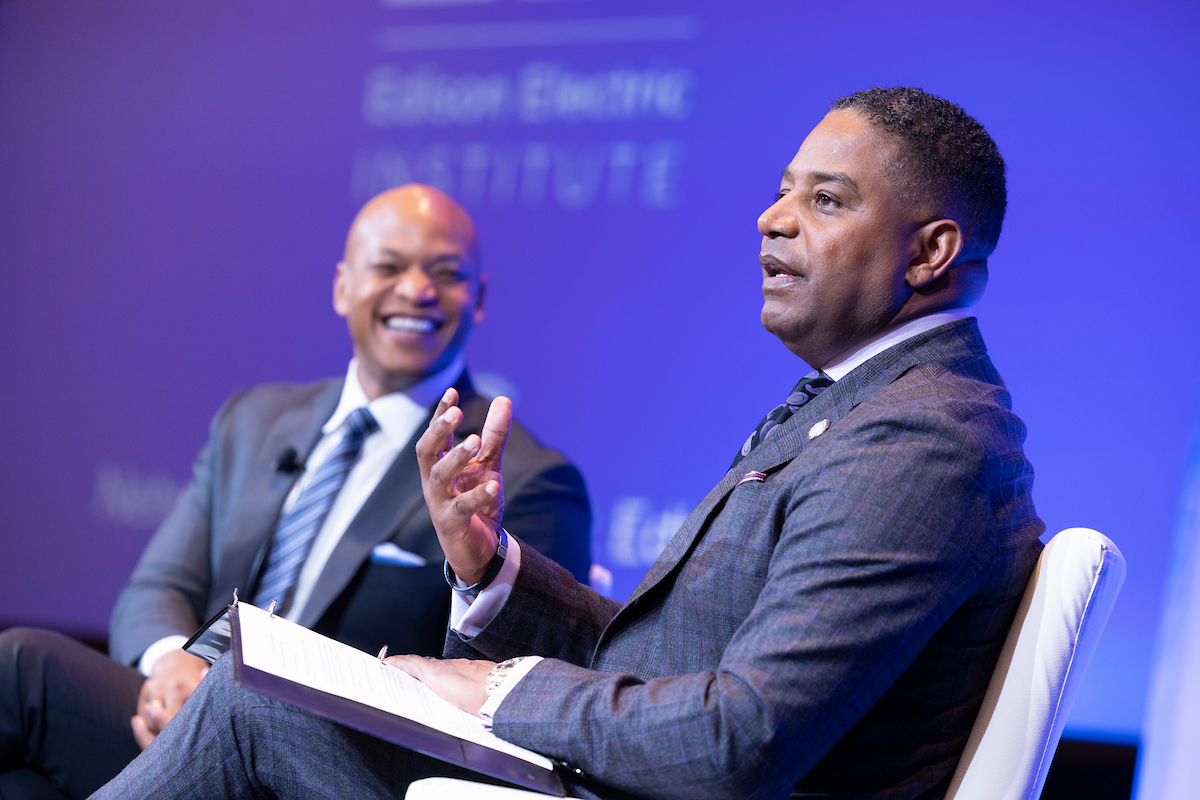
Butler speaks with Maryland Governor Wes Moore at EEI’s 2024 Spring Board of Directors and Chief Executives meeting.
EP: In announcing your role as EEI vice chair, you emphasized your commitment to an equitable clean energy transition. What does that mean to you, and what can the industry do to ensure equity?
CB: What drives me as Exelon’s CEO is putting more energy in equity and more equity in energy. I want the entire industry to join me in these efforts. As we build a clean energy future, we must do so in a way that benefits underserved and diverse communities—women, people of color, and other groups that traditionally have been left out.
What’s important to keep in mind is that equity isn’t the same thing as equality. Equity means providing each person the exact resources and opportunities needed to reach an equal outcome—even if those resources or opportunities look different from person-to-person, or from group-to-group.
Let me give you an example: The American Lung Association has released air quality reports for different communities. Over the years, they’ve found that the burden of air pollution is not evenly shared. Poor people, people who live in lower-income and racially diverse communities, and certain ethnic groups often face higher exposure to pollutants, suffer more from asthma, and even have a higher risk of premature death from polluted air.
The studies point to decades of residential segregation, noting that African Americans tend to live where there is greater exposure to air pollution. These same communities also are often disproportionately impacted by climate change. When we as an industry are focused on the clean energy transformation—even though we all want to get to the same outcome—we can’t treat those communities and groups the same as we would other communities that have been less impacted by historical burdens.
Exelon and its affiliates have been working on a range of equity-minded initiatives to accelerate the clean energy transition and improve air quality, including helping our regions secure federal grants. One area that we are focused on is the electrification of transportation and, specifically, school buses. If we replaced all of the diesel-powered school buses in the United States with electric school buses, we would reduce our annual emissions by 9 million metric tons. That’s the equivalent of taking 2 million cars off the road.
So far, nine school districts across Exelon’s service areas have received more than $40 million in grant funding to electrify more than 100 buses. Equity means serving those school districts and communities strategically to attain equal outcomes.
As we move toward greater electrification, we should ask ourselves: Are we ensuring that all of our communities are benefiting? Are we installing charging infrastructure in limited-income communities, or only in wealthy ones? Are job applicants from underserved and under-resourced communities being trained to be the electric vehicle mechanics we’ll need in the future? The environmental and resilience benefits of electrification are important. Issues of access and equity should be equally important to all of us.
When we tolerate disparities—when we overlook imbalances of resources and opportunities in the name of equality—we limit progress for individuals, communities, cities, and our industry. That impedes progress for all of us. Unfortunately, I have found that some people see equity as a zero-sum game. Prioritizing one underserved group may be seen as coming at the expense of another. That kind of thinking is detrimental to our collective progress.
EP: What is your view on the industry's role in balancing customer affordability with the critical investments that are needed to build next-generation infrastructure, to enhance energy grid security and resilience, and to integrate a growing fleet of renewable energy sources?
CB: Exelon’s priority always is reliable and resilient service. Exelon serves customers in rural, urban, and coastal communities and across the economic spectrum, and each jurisdiction is different and has its own objectives set by policymakers.
Our focus on equity and affordability shows up in several ways:
- We work with our local regulatory bodies to develop rate-making processes that balance customer affordability with our need to make critical upgrades to the energy grid.
- We identify smart investments, where a single project can address multiple priorities. We also need to remember that some investments, like transmission, can facilitate lower costs or enable renewable energy for a larger geographic area.
- We prioritize programs that enable customer savings through home energy audits, lighting discounts, appliance recycling, home improvement rebates, equipment upgrade incentives, and innovative programs like smart thermostats and combined heat-and-power programs.
- We connect customers with assistance. In 2023 alone, Exelon helped connect approximately 470,500 customers to $476.5 million in energy assistance—$186.4 million of which came from the Low Income Home Energy Assistance Program.
Historically, each of Exelon’s companies has maintained customer bill averages that are lower than the national average. That is the result of prudent, customer-driven investment and disciplined cost management. We take an integrated approach to making the best use of quality existing assets, including gas pipes and electric wires, to minimize transition costs to our customers and total system costs over time. This helps to ensure that efforts to reduce carbon emissions do not limit energy access or affordability.
We also try to design initiatives, programs, and services to meet the needs of limited- and moderate-income households. Dedicated programs for limited-income energy efficiency and community solar—and electric transportation options, including school buses and public transportation—help ensure equitable access to clean energy resources.
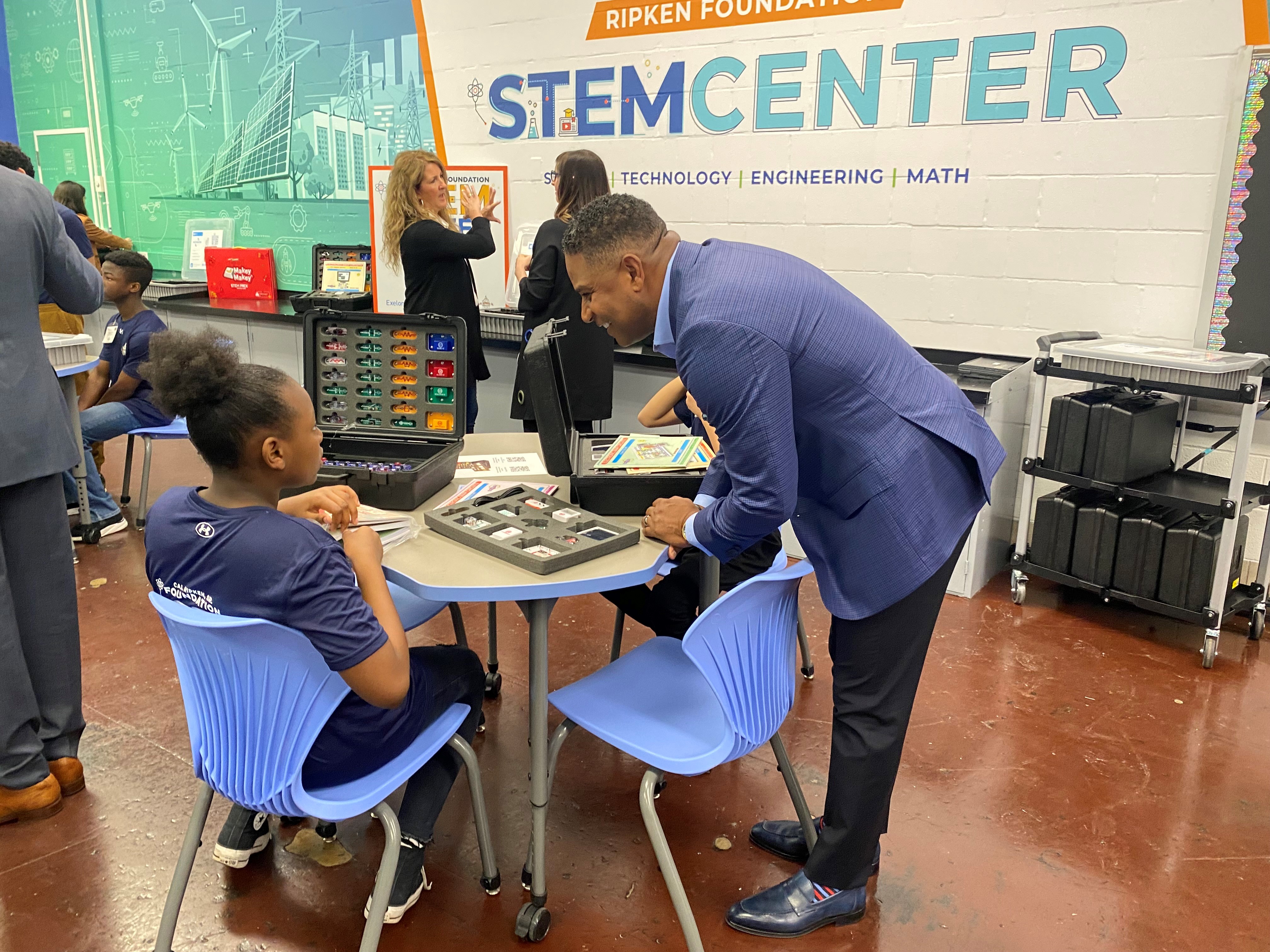
Butler visits a Baltimore-area middle school to advance science, technology, engineering, and math education opportunities.
EP: Exelon and its subsidiaries span several different states and jurisdictions. Can you speak to the challenges and opportunities that electric companies may face when serving such a large and diverse service territory?
CB: We serve 10.5 million customers in five states and Washington, D.C., through six local energy delivery companies. We serve some of the largest and most diverse metropolitan regions in the United States, but we also serve large swaths of rural America, customers in landlocked farming communities, and coastal areas in Delaware, Maryland, and New Jersey. We must have a multi-faceted and inclusive approach to everything we do and every decision that we make.
However, each jurisdiction has different priorities and timelines. Our governmental and regulatory affairs teams work very closely with stakeholders across local governments, commissions, and community groups to understand their needs and to align them with our business plans.
This can be challenging. What is tremendously helpful is the way we share learnings across our company. For example, Pepco, which serves customers in and around Washington, D.C., was our first local energy company to file a multi-year plan for gradual rate increases. This offers long-term certainty and benefits for our customers as we continue making infrastructure investments that support their needs.
BGE was able to learn from those efforts to adapt a plan for customers in central Maryland. We later went on to propose a multi-year plan in Illinois, and, although the initial regulatory response was not what we had hoped, the learnings from our other jurisdictions were key in helping our team at ComEd regroup and file a new plan, which we hope will meet the needs of our customers and the state’s clean energy and equity goals while preserving ComEd’s nation-leading reliability.
Across the country, our customers must be our focus. At Exelon, we are prioritizing our investments to deliver on customer needs and the goals of the communities and states that we serve. As an industry, we all must do our part, both individually and collaboratively.
With rising geopolitical concerns from the wars in Ukraine and the Middle East to rising tensions with China it is more important than ever that we continue to refine our existing security strategies while adding new tools to the toolbox.
“We must have a multi-faceted and inclusive approach to everything we do and every decision that we make.”
EP: Service is a hallmark of leaders in this industry. And, it has been a hallmark of your career. How has service made a difference in shaping you as a person and a leader?
CB: I want to make sure that my influence in this role helps others, whether that’s through serving on boards that are working to change the industry for the better—such as the U.S. Department of Energy’s (DOE’s) Argonne National Laboratories—or in community-focused organizations—such as the Cal Ripken, Sr. Foundation (Ripken Foundation), which is creating opportunities for young people in need to develop valuable life skills.
We recently announced the launch of a three-year educational initiative between the Exelon Foundation and the Ripken Foundation, aimed at developing the next generation of STEM experts and future energy leaders. Through a $3-million partnership, we will open 81 STEM centers—with 3D printers, robotics, and other advanced technologies—in schools across Maryland and Washington, D.C.
I hope that my passion for service is evident in the way I give members of my team the guidance and tools that they need to succeed—and then let them grow, develop, and ultimately thrive. I want them to be empowered to serve others, as well.
As a young professional, one of the people I looked to as a role model was Reginald F. Lewis, the first African American man to build a billion-dollar company. He was a giant in the business world. But, he also was incredibly generous and had a heart for service. He donated millions of dollars to nonprofits and educational institutions. His hard work continues to leave a legacy.
What’s gratifying for me is the thought that, when I retire—which will be a long time from now—I will be able to look back on the work we did at Exelon and the organizations I’ve contributed to and feel good about how we’ve changed communities and changed lives.
There are many other great examples of DEI programs and initiatives throughout the industry. What is clear is our shared commitment to developing the workforce that we need to deliver a resilient clean energy future.
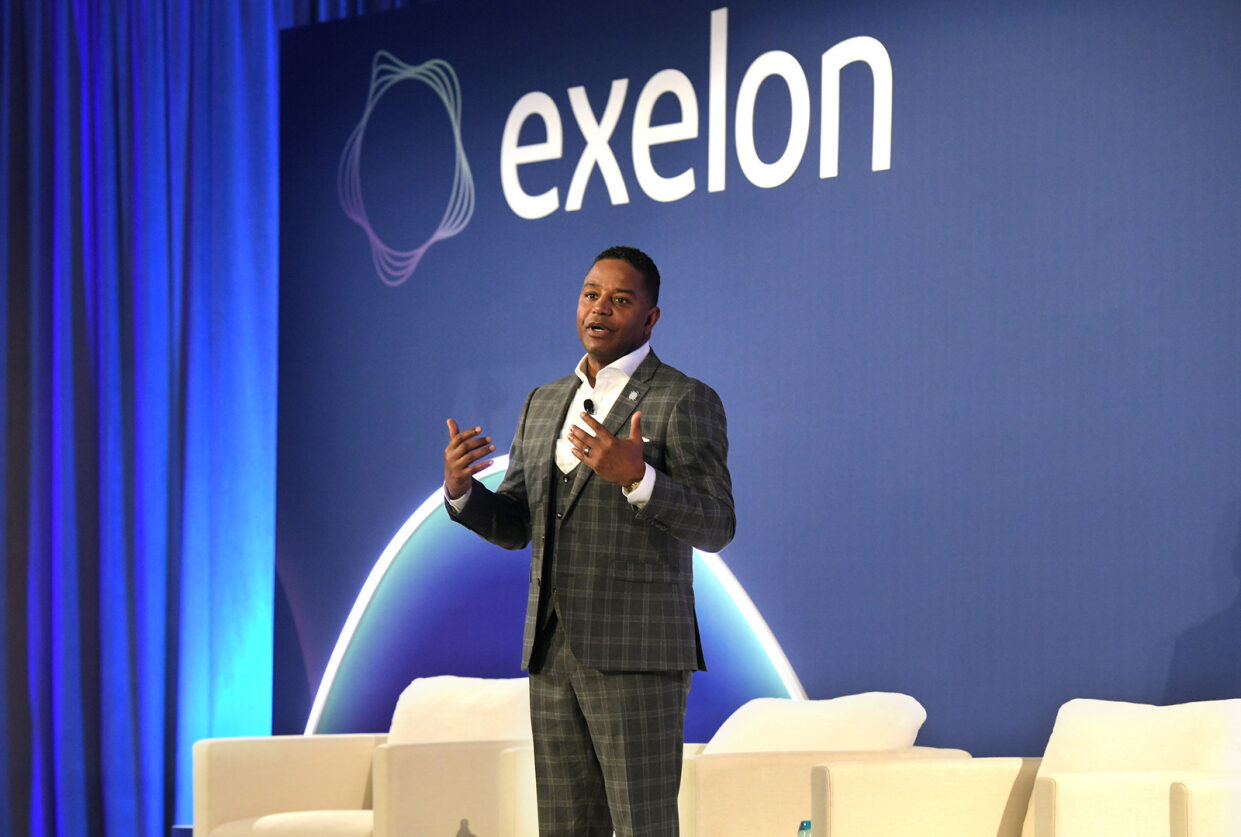
"I want to make sure that my influence in this role helps others," Butler says.
EP: Last year, you attended a cross-sector White House CEO meeting to discuss U.S. economic growth. How do you view our industry’s role in the U.S. economy, and what is your perspective on industry-government partnership?
CB: It was a tremendous honor to represent Exelon at a meeting hosted by President Joe Biden last year. He invited a handful of company executives to discuss how we can help everyday Americans thrive in today’s economic environment. Going into the meeting, I didn’t know that the president was going to meet with us in the Oval Office rather than the Roosevelt Room. I was honored and humbled to sit alongside so many titans in the business world, such as Ken Chenault, the former CEO of American Express, who was one of the few African Americans in such a role at the time.
Having a seat at the table not only offered Exelon a platform for sharing our viewpoints—it also was a coveted opportunity to partner with government leaders at the highest level. The president devoted almost two hours to discussing the economic factors that impact all Americans and how the government and private sector can partner to develop solutions for building a stronger economy.
I appreciated the opportunity—and I recognized in the moment that I wasn’t in that room as just Calvin Butler. I was representing Exelon’s 20,000 employees and our more than 10 million customers. I was representing all of EEI’s member companies. That’s quite a privilege and a tremendous responsibility.
That meeting came after the passage of the Bipartisan Infrastructure Law and the Inflation Reduction Act, both of which created tremendous opportunities to accelerate infrastructure investments and hasten the clean energy transition. Those two bills incentivize jurisdictions to aggressively pursue climate goals. Last year, Exelon submitted funding and grant applications totaling nearly $700 million to DOE, which would support 10 critical grid infrastructure projects across the country and potentially create more than 7,800 jobs.
The electric power industry supports more than 7 million jobs in communities across the United States. Our role in the economy is a major one, and we directly and indirectly support so many good-paying positions that require skills and technical expertise but may not require a four-year degree.
EP: What does our industry need to do to foster the diverse and talented workforce that will be necessary as we pursue a resilient clean energy future?
CB: We have a responsibility to help attract and retain a skilled, diverse workforce—not just here at Exelon, but across the industry. Our commitment to inclusion is shaped by who we are and who we serve. We use a comprehensive approach to drive a diverse, equitable, and inclusive culture within our communities by choosing to work with partners who share our core values—extending to our vendors, our consultants, and even our charitable grant recipients. It is through these efforts that we provide superior service to our customers.
When inclusion is woven into the mission, vision, and business practices of a company, it will be sustained over time. When it is treated as a nice-to-have initiative or program, it will not yield the results intended. As with many things in the world of business, culture change begins at the top. We prioritized inclusion as a core value at Exelon over the years. And, I can tell you, it has made a difference.
We require diverse slates of candidates in our recruiting process and diverse interview panels. We support well-funded employee resource groups, each led by a sponsor at the executive level. And, we pride ourselves in creating a work environment where all employees are encouraged and feel safe to bring their best professional selves to work. We measure these sorts of cultural impacts, like we would anything else that matters to us.
We also prioritize external workforce development. We invest in local communities to help build the skills necessary for the jobs today and for the energy workforce of the future. Since 2019, when we realigned our companywide workforce development strategy, our efforts have helped support the hiring of more than 1,800 people who live in communities served by Exelon into positions at our local energy companies or with our contractors. These are well-paying, family-sustaining positions.
Exelon is going all-in to bring about change, and the entire energy industry must join us. In an industry that offers so many opportunities to make a difference—through electric power generation, transmission and distribution, energy storage, energy efficiency, cybersecurity, data analytics, customer experience, fleet electrification, and so much more—our industry should, can, and must be a strategic disruptor to economic inequities in our communities.
As we enter a critical new era—where the type of energy that we generate and deliver, and the way we deliver it, is evolving at a rapid pace—we will see more change in the next 10 years than we have seen in the last 100 years. That makes this a truly exciting and transformational time to be in this industry. EP