Meeting the Resource Adequacy Challenge: The Case for RICE
As resource adequacy rules evolve to emphasize reliability, flexibly dispatchable resources like reciprocating internal combustion engines are positioned to outperform turbine technologies. (Sponsored Content)
After decades of relatively stable energy demand, forecasted load growth—driven primarily by data center development—is at its highest level in the past two decades. Across the United States, soaring demand is straining available capacity and inflating prices. Simultaneously, grid operators face a growing gap between their system’s installed nameplate capacity and the accredited capacity resources can deliver during the highest-risk hours.
Rapid demand growth is colliding with the retirement of dispatchable resources and their replacement by predominantly intermittent renewables. A Goldman Sachs report infers that AI-driven growth could require another 47 gigawatts (GW) of power by 2031, the equivalent of California’s 2024 peak load. Meanwhile, NERC reports that 115 GW—comprised mostly of large, dispatchable resources—will retire by 2034, and 85 percent of the replacement megawatts will come from weather dependent resources.
In systems nationwide, the expanding gap between installed and accredited capacity highlights the need for resources like reciprocating internal combustion engines (RICE) to deliver dependable, dispatchable capacity. This widening resource adequacy delta is not solely attributed to weather-dependent resources. In the Midcontinental Independent System Operator's (MISO's) latest Planning Resource Auction, poor availability of older coal and natural gas generation reduced system-wide accredited capacity by nearly 5 GW. Moreover, as high-demand events during the shoulder months become more common, planned maintenance removes critical thermal generation during the spring and fall.
As resource adequacy rules evolve to emphasize reliability, flexibly dispatchable resources like RICE are positioned to outperform turbine technologies. For example, Energy Information Administration data shows that across PJM, MISO, and the Southwest Power Pool, engine power plants consistently demonstrate strong rated capacity performance–averaging 12.5 percent better in summer and 2.75 percent better in winter than turbines.
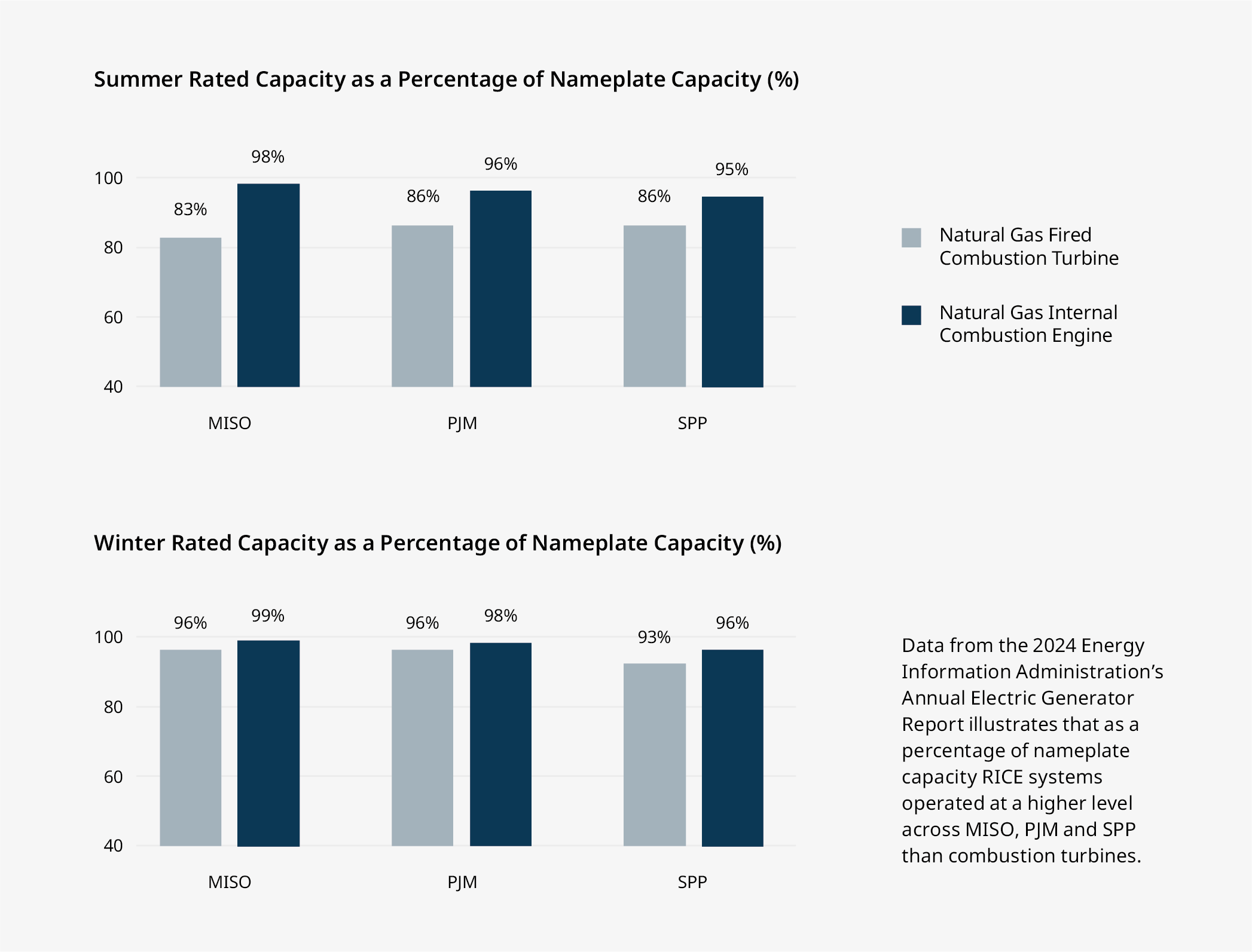
RICE’s competitive edge is ascribed to its resilient technological attributes. When turbine output derates as ambient temperature rises, RICE’s output remains stable as temperatures climb above 100°F. Conversely, when cold temperatures strain natural gas availability, engines maintain reliability at 80 percent lower gas pressure than aeroderivative turbines. Additionally, when planned maintenance removes turbine plants from service, modular engine systems enable maintenance to be performed in rotation while continuing to supply megawatts to the grid. During unplanned outages, RICE’s modularity provides redundancy that reduces the likelihood of catastrophic, whole-plant outages.
Amid unprecedented load growth and rising costs, grid operators nationwide are implementing market reforms that incentivize resources with higher accreditation values. With resiliency-minded attributes and unmatched flexibility, Wärtsilä’s RICE systems should be a contender for any load-serving entity committed to reliability and long-term value.