
Celebrating the Barbarians: Tom Fanning on Security, Perseverance, and "The Art of War"
Tom Fanning, who retired as executive chairman of Southern Company on December 31, recently spoke with Electric Perspectives to share his thoughts on the evolution of the electric power industry throughout his career—and on his role in helping reimagine industry relationships with stakeholders in government and the private sector. Fanning held several leadership positions at Southern Company before serving as chairman, president, and CEO from 2010 to 2023. He received EEI’s Thomas A. Edison Legacy Award in September for his decades of service to the industry and his leadership in enhancing industry-government coordination.
Read more about the award and Fanning’s impact on the industry in the November/December 2023 issue of EP.
Electric Perspectives (EP): What are some of your proudest accomplishments from your decades of service in the electric power industry?
Tom Fanning (TF): First and foremost, running Southern Company—one of the great companies in the world, when you consider our economic significance and our mission of delivering clean, safe, reliable, and affordable energy to our customers.
Getting Vogtle done—the first newly constructed nuclear unit to be built in the United States in more than 30 years—also was significant. Vogtle required resilience. It required vision. It required courage. To see that come to fruition—knowing that we were able to keep the aircraft carrier running optimally on top of making sure that Vogtle was a success—was a very rewarding thing.
Additionally, Southern Company gave me a platform for a lot of external engagement, which had three focuses: engagement in national energy policy; my long-standing involvement with the Federal Reserve Bank of Atlanta; and national security engagement, particularly over the past decade. That national security work really started with the creation of the Electricity Subsector Coordinating Council (ESCC) more than a decade ago, and it progressed into my own e orts to reimagine national security in a digital realm.
That meant redefining private-sector interconnections and how the private sector should work with government to preserve and enhance our national security. That manifested in my appointment to the Cyberspace Solarium Commission and then my role as chair of the Cybersecurity and Infrastructure Security Agency’s Cybersecurity Advisory Committee, which came through a White House appointment.
I was never identified as a Republican or a Democrat. I developed a reputation for being able to work with anyone for the betterment of America. That has been very fulfilling.
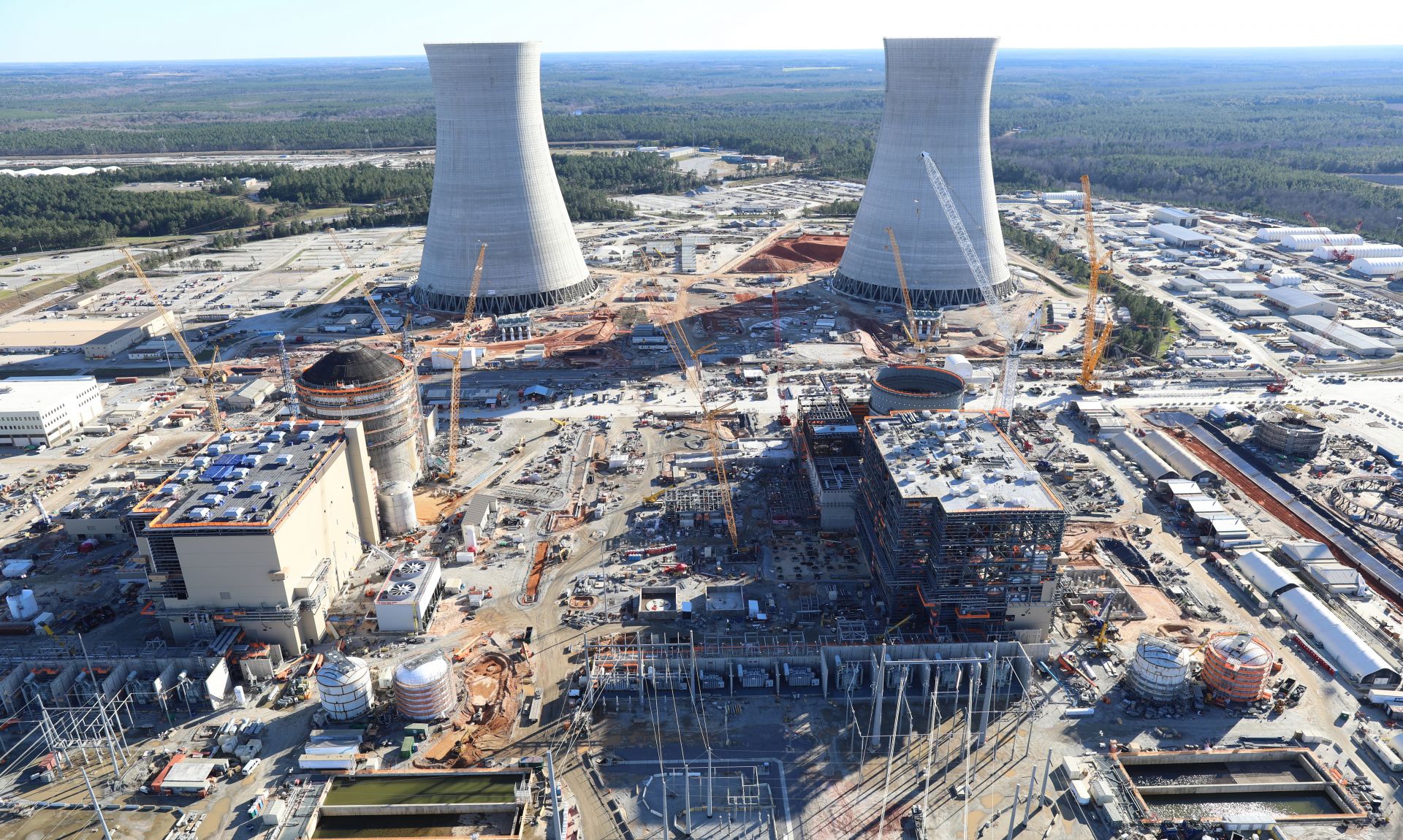
When Vogtle Unit 3 went online in 2023, it became the first newly constructed nuclear energy plant to be built in the United States in more than 30 years.
EP: You mentioned the importance of industry-government and inter-industry coordination. Can you speak to the signi cance of these partnerships and how they have evolved?
TF: It was very clear, when I became the co-chair of the ESCC in 2013, that living within a silo had been adequate to a point but was sorely insufficient to carry out our mission. The U.S. economy is built upon interdependence. Thinking only about electricity issues is very short-sighted.
In thinking about redefining the relationship between the private sector and the government, particularly around security, it is important to remember that the dogma of not fighting battles on other people's shores doesn't apply. In a digital world, there are no borders. There are no friendly oceans east and west. The bad guys are attacking our systems hundreds of millions of times each day.
When you come from our industry, you know that electricity represents 5 percent of the U.S. economy—but it’s the first 5 percent. It is the most fundamentally important piece, and it is foundational to our economic and national security. We built momentum when we started linking with other lifeline sectors, particularly finance and communications. We created the Tri-Sector Executive Working Group, which united electricity, finance, and communications to support our national and economic security.
In thinking about redefining our relationship with government, I want to acknowledge recent administrations led by Presidents Barack Obama, Donald Trump, and Joe Biden. All have treated us in a non-partisan way. We've built, in my experience, an effective relationship with our sector's risk management agency—in our case, the U.S. Department of Energy (DOE). The leaders at DOE have been terrific partners with us. Of course, EEI President and CEO Dan Brouillette was one of those leaders when he served as U.S. Deputy Secretary of Energy and then U.S. Secretary of Energy.
EP: What are the most important shifts in public policy affecting our industry that you have seen in your career?
TF: Concern with the climate has been a giant ocean current for our industry—to help lessen the effects of climate change and define our industry's role. That touches carbon emissions, but it's a much broader issue than that.
One thing to watch out for, as I tell my successors at Southern Company and in the industry, is: Don't let yourself get funneled into single-issue politics. Our mission in the electricity industry is defined by clean, safe, reliable, and affordable. We have to think about that broad mandate. We have to maintain balance while pursuing multipronged objectives.
And, former EEI President and CEO Tom Kuhn deserves great credit. Certainly, not every company agrees with everything that Southern Company does. But, one of the benefits of EEI is this Power by AssociationSM. I always laughed and said Tom was our chief psychiatrist. He kept us together, and he became a real icon for the folks in Washington, D.C., in terms of his effectiveness. Our industry is too important to fall into parochial factions, and Tom has really helped us avoid that.
“Our mission in the electricity industry is defined by clean, safe, reliable, and affordable.”
EP: You have previously spoken of the importance of leading by principle. In 2015, you published Leadership Perspectives, a book that features leadership mantras and nuggets of wisdom that have helped guide your career: “Be here now.” “Fix the roof while the sun is out.” Where did these mantras come from, and do you have any favorits that have helped make you an impactful leader?
TF: I am a fan of off-the-wall analogies and metaphors for our business. And, two of my favorites have actually been two other books. One was Barbarians at the Gate, which teaches the simple lesson that, if you don’t run your business as well as you can, someone else will. The second was The Art of War by Sun Tzu.
I have always been fascinated with the idea of how best to reach people, and this book was one way I attempted to do that. My first idea for it was based on how The Art of War relates to Southern Company. I took concepts from that book and explained what they meant to the business. But, it was too dense and deep and long. I put it aside and decided that I wanted something that could be digested on a plane ride. I wanted it to be punchy. That became Leadership Perspectives. It still pulls from The Art of War and Barbarians at the Gate, but it is quick and to the point.
One idea I talk about is aspirational behavior. There are those of us who get their energy not from the here and now, but from what may be. And, when you think about legacy, how much better off would society be if people thought about legacy very early in life? How do you want to act now to create a legacy that benefits other people? Defining how you operate in life should always be anchored in the “them,” not the “you,” which is one of the hallmarks of our industry.
I’ve coached football for many years. And, one of the ideas I’ve given to kids is: If you’re not early, you’re late. If you’re late, you are not respecting the mission or other people’s time. I run meetings that way. We don’t delay meetings because somebody isn’t there. We go.
Another idea, whether it’s work or a sport, is to bring three things to everything you do: Do the right things, do them to the best of your ability, and bring a sense of fun to whatever you do. If work is fun, you never work a day in your life.
I also use a lot of movies as metaphors. The greatest movie ever written, Casablanca, has a famous line when Rick, the protagonist, is talking to a police chief. The chief says, “Rick, I just blow with the wind.” He takes what comes. Taking what comes, in my opinion, is lethal to corporate culture. You have to influence your environment. Similarly, one of the most important ideas in the book, The 7 Habits of Highly Effective People, is proactivity. I am not acted upon. I choose to act. That’s the same concept. If you don’t like the way things are, in work or in life, change them. Make your environment as good as it can be.
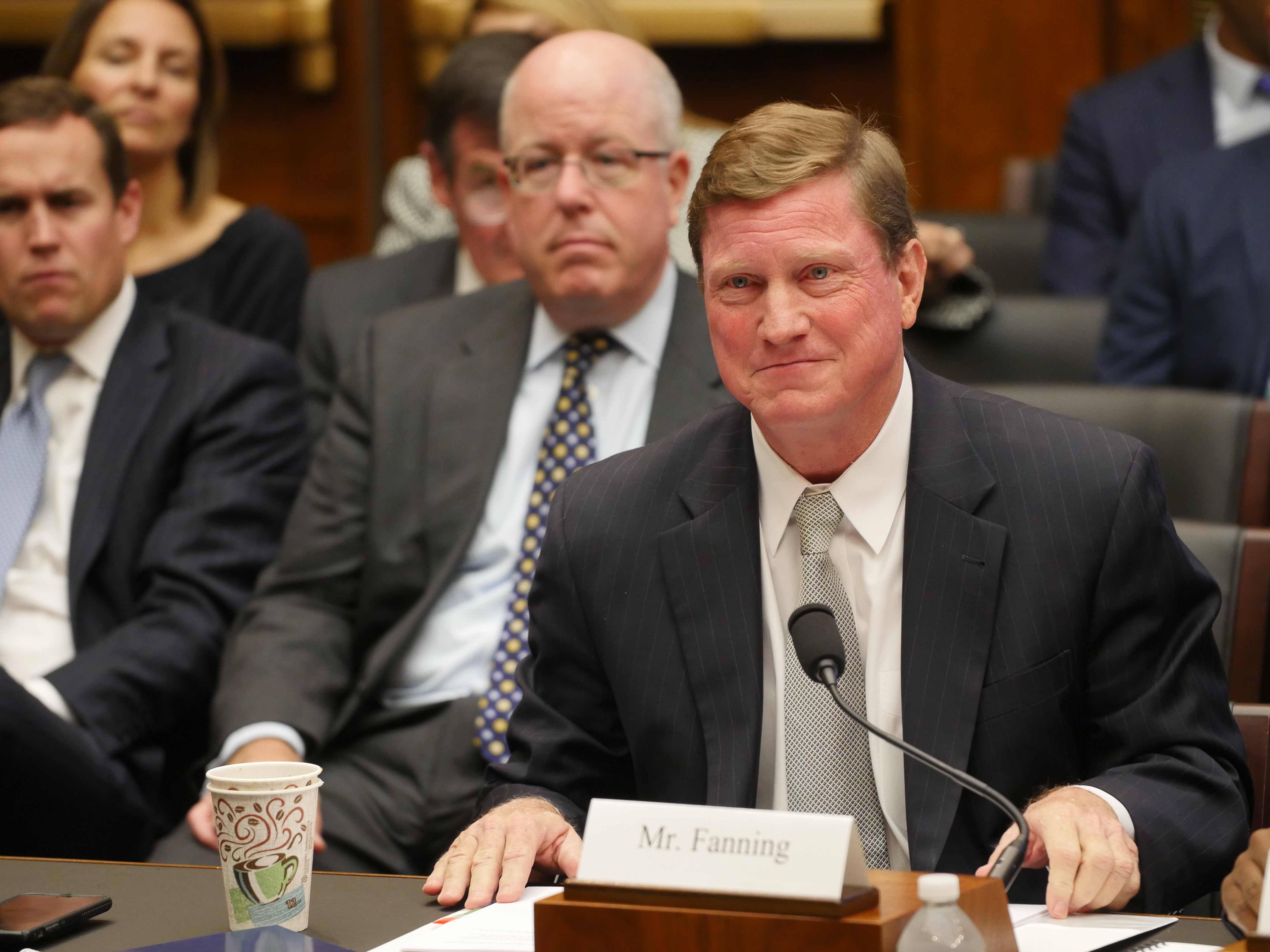
Throughout his career, Fanning worked with government leaders to help make the grid more secure and resilient. Shown above, he testified before the U.S. Senate Judiciary Committee's Subcommittee on Crime and Terrorism in 2018.
EP: Thomas Edison once said, “Our greatest weakness lies in giving up. The most certain way to succeed always is to try one more time.” How has the concept of perseverance factored into your work at Southern Company?
TF: The tougher the issue, the more you will find yourself in the minority when you get to the moments where perseverance, courage, and vision matter. If everybody felt that what you were doing was the right thing to do, it would be easy to get tough things done.
Now, you had better be right. You had better be open to changing your course of action. If you think about Vogtle, we had our major constructor, Westinghouse, go bankrupt. We had their parent, Toshiba, on the verge of bankruptcy and owing us $3.7 billion. We had support from the federal government in the form of tax advantages and loan guarantees, and those were set to expire. We had the COVID-19 outbreak. We had the Fukushima nuclear accident.
All of those moments tested our perseverance. In dealing with COVID-19, I remember working with Sean McGarvey, the president of North America’s Building Trades Unions. We had very tough conversations at the outset. What was this virus? Did we have to shut down the project? We had 10,000 people on a limited site in Georgia. How do you keep that going?
Our conviction was to make that site the safest place on earth. We had to change work practices. We decided to put a medical village onsite, and we moved essential medical facilities there. It takes a whole lot of effort, persuasion, and an unmitigated belief that what you’re doing is right and necessary and important to get those things done.
EP: How can the industry continue to develop the careers of promising young professionals?
TF: The first thing we can do is acknowledge how fundamentally important our work is. Not to denigrate soft drinks, but if all I did every day was get up and worry about how to sell brown sugar-water, I wouldn't feel as convicted as I do in this industry. What we do really matters to people.
Second: Ask the question, “Do I have the ability to influence an outcome for the betterment of society?” In this industry, absolutely. That is a very powerful motivator, and it speaks to our culture. We have been so successful at moving and selling electricity over the years, but the greatest harbinger of future failure is past success. People tend to get wedded to the way things went last year if last year was successful.
What I’ve tried to do is cultivate a celebration of the barbarians—of the people who come in and, for all the right reasons, challenge conventional wisdom . They want to make things better. Frankly, that is also the mission of a CEO. What you want to do is protect these people and nurture them, because the body politic of a successful culture will be to reject changes. But, these barbarians are so useful in helping to move company culture forward. EP