
Committed to Resilience: A Q&A With Entergy's Drew Marsh
Drew Marsh is chair and CEO of Entergy, an integrated energy company that powers the lives of 3 million customers in Arkansas, Louisiana, Mississippi, and Texas. In an interview with Electric Perspectives, Marsh shares his thoughts on demand growth, grid resilience, and the importance of a customer-driven mindset.
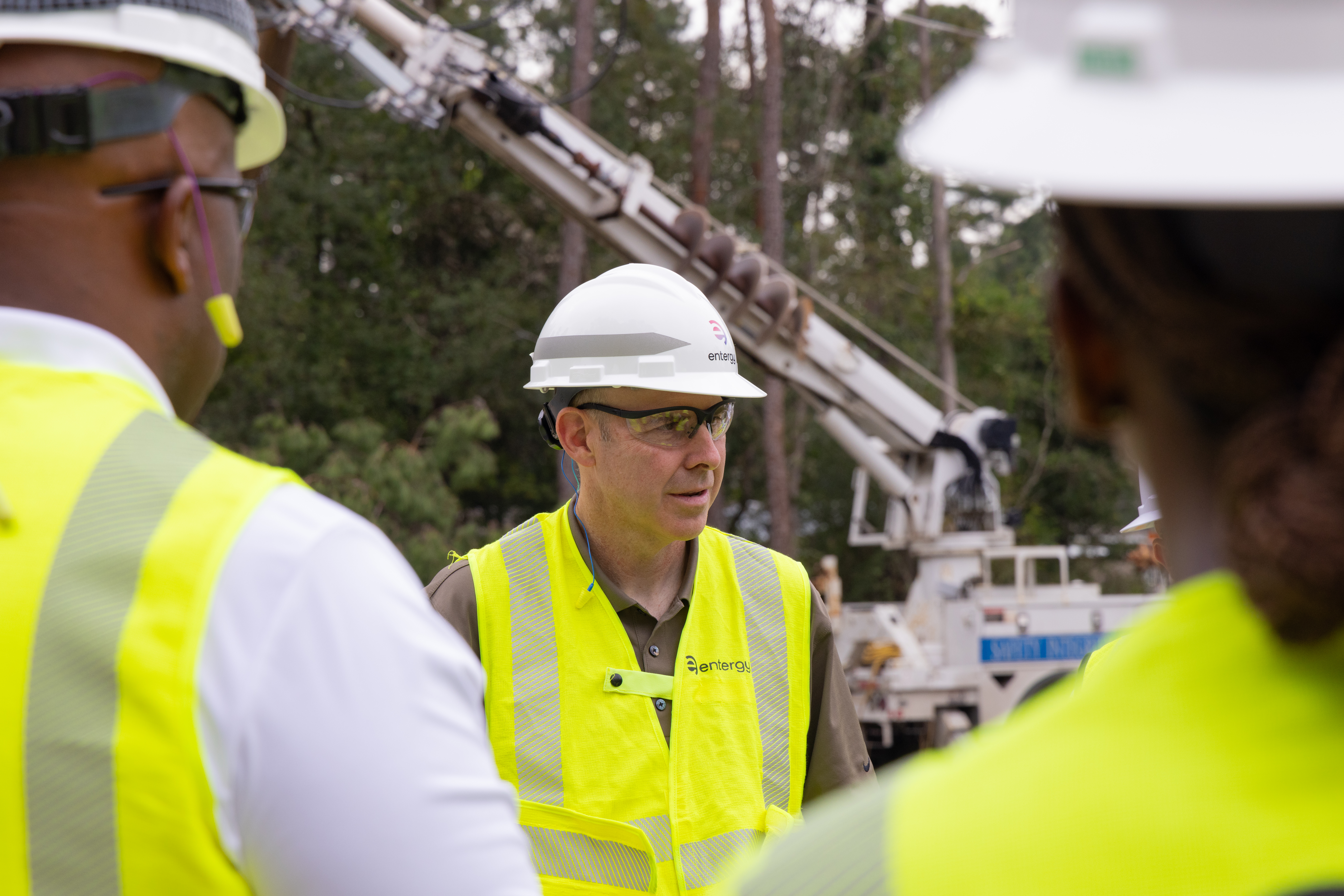
Electric Perspectives (EP): How has customer demand evolved during your three years as Entergy CEO and in the nearly three decades that you have been with the company?
Drew Marsh (DM): The demand growth that’s taking place across the country and in Entergy’s service area is unlike anything we have seen in recent history—and, in some ways, ever.
Not only is the need for electricity at an all-time high, there’s also an explosion of economic activity in the Gulf South that is bringing new opportunities, new industries, and new customers to the region we serve. It is an exciting time to be leading Entergy. We’re in a unique position to respond to several favorable trends—including technological advancement and the buildout of data centers, the onshoring of industrial and manufacturing activity, increased demand for clean energy, and electrification throughout the economy.
I am proud of our work to develop a customer-led plan that will drive continued growth, reliability, and resilience in the years ahead. Through 2028, we plan to invest $37 billion in critical energy infrastructure, including generation, transmission, and distribution. We’re also building new natural gas infrastructure across our service area, with regulatory approval pending on a series of combustion turbine plants in Arkansas, Louisiana, and Texas that include accommodations for carbon capture technologies. We need to continue to embrace new technologies and to lead with innovation when it comes to powering the lives of our customers.
What has not changed for Entergy is our customer and community focus. For more than 100 years, we have been committed to serving our customers and to keeping their energy costs as low as possible—which is especially important in our region, with 40 percent of our residential customers living at or below the poverty line.
It’s our responsibility to balance building and strengthening the energy grid of the future with the needs and realities in our communities. We do this in a number of ways. Last year, Entergy launched the Leading Energy Affordability for All Task Force, which works with external partners to ensure our customers benefit from the $1.1 billion in grants, rebates, and funds available across our service area, including home energy rebates. While each of our Entergy operating companies has unique regulatory requirements for offering support through energy efficiency and demand response programs, we are united in our efforts to provide reliable, affordable, and increasingly clean energy to the customers and communities we serve.
Upgrades and expansions to Entergy Louisiana’s generation and transmission infrastructure will help power a planned $5.8-billion Hyundai Motor Group steel manufacturing facility in …
EP: You mentioned your region’s industrial growth and new data center customers. What do you see as the key drivers of interest and investment in Entergy’s service territory?
DM: There are a number of natural advantages along the Gulf Coast and the Mississippi River. We are home to the largest industrial base in the United States. People all over the world are looking at the United States for investment opportunities, and our access to global markets matters for our industrial customers—as does our ease of access to ports, pipelines, rail lines, and domestic markets and supply chains.
Low energy costs and abundant energy transportation have long been drivers of economic activity in our region. They’re part of the reason why Meta is investing $10 billion to build a 1,500-megawatt (MW) data center in Richland Parish, La., why Amazon Web Services is dedicating $16 billion to a 650-MW data center project in Madison County, Miss., and why Hyundai Motor Group is planning to build a $5.8-billion steel manufacturing facility in Donaldsonville, La.
In our conversations with these customers, we discussed how Entergy offers benefits to them through our vertical integration and deep ties to our communities. We’re able to convene diverse groups of stakeholders when speaking with new customers, bringing elected officials, community leaders, and local vendors to the table. This is the power of partnership, and the aligned vision across all parties involved helps bring new jobs and dollars to the states we serve. The economic impact to our communities is significant.
Speed-to-market matters, particularly to our data center customers, and we’re able to collaborate and move quickly and comprehensively to bring new opportunities to our communities. Our customers also benefit from Entergy’s diverse energy mix. Modern natural gas accounted for 43 percent of our generating capacity last year—with carbon-free generation sources, including nuclear energy and a growing portfolio of renewables, accounting for nearly 25 percent.
Entergy has 1,600 MW of renewable capacity in service and brought more than 700 MW of solar online in 2024 alone, with the goal of advancing an additional 5,000 MW through 2028.
Many of our customers have their own emissions reduction goals, and our diversity of generation makes us a valuable partner that can provide reliable and affordable service.
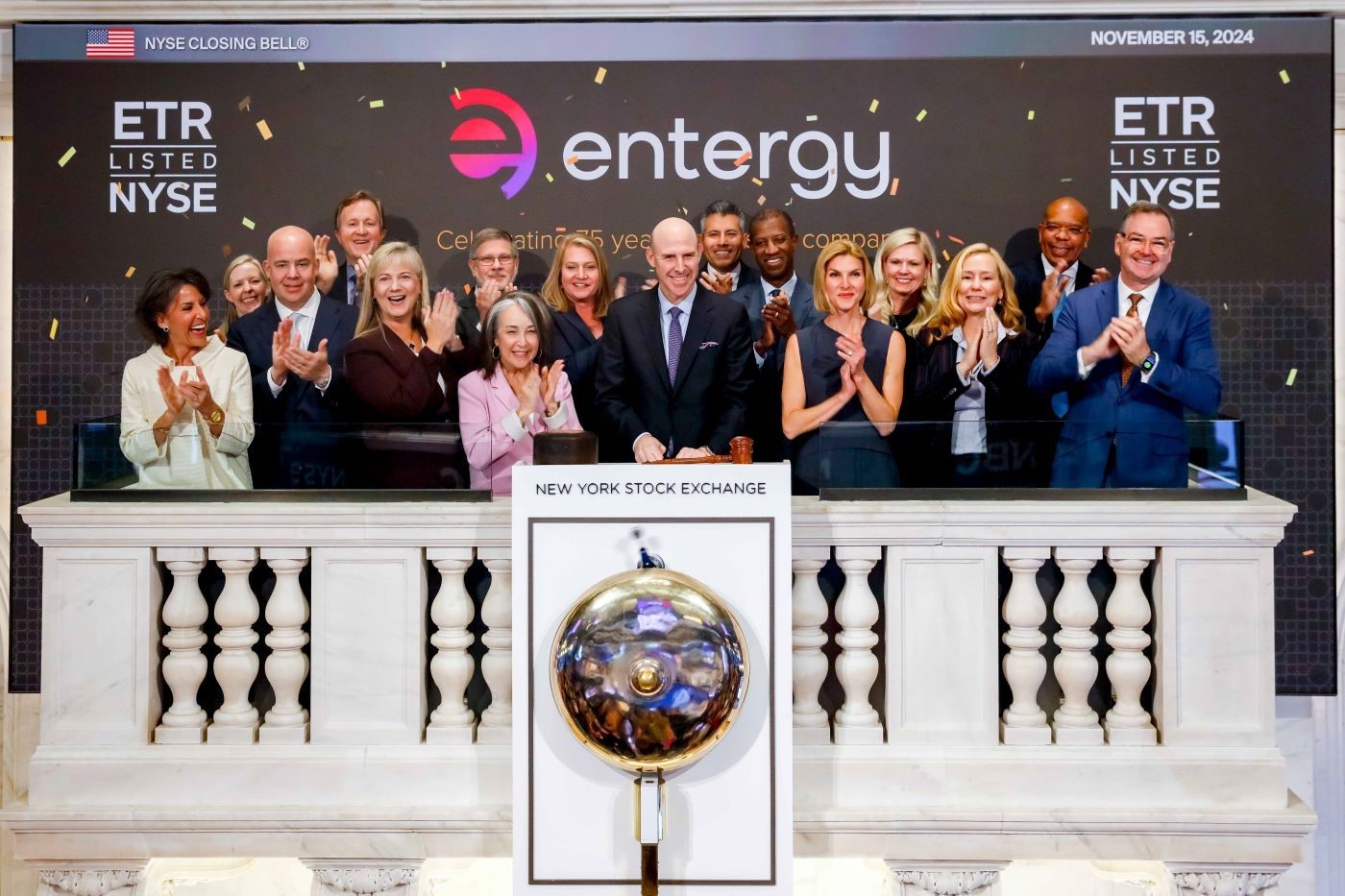
In January, Marsh joined Entergy's executive leadership team to ring the New York Stock Exchange's closing bell.
EP: Building a secure and weather-resilient grid has become one of the industry’s top priorities. How are the hardening and resilience initiatives that you are leading at Entergy helping to protect your customers and communities?
DM: Much of Entergy’s footprint sits along or close to the Gulf Coast. While the geography offers unique advantages, it also makes us susceptible to hurricanes, floods, wildfires, and other severe weather events.
The energy grid we operate today was mostly built decades ago to a different standard and expectation than today’s modern life. That means it’s up to us and our government and regulatory partners to maintain and build a reliable and resilient grid for our customers with current weather patterns in mind.
Last year, Entergy Louisiana launched a five-year, $1.9-billion resilience plan that will see more than 2,100 projects aimed at hardening Louisiana’s energy transmission and distribution infrastructure. In January, Entergy Texas received approval for the first phase of a three-year, $137-million effort to reduce storm-related outages and to harden the Southeast Texas grid. Similar efforts in Arkansas, Mississippi, and throughout our region demonstrate our commitment to ensuring customers have access to power when they need it most.
Across our service area, we have invested more than $10 billion during the past five years to strengthen our transmission and distribution infrastructure, and we plan to make similar investments of $16 billion through 2028 to further support reliability and resilience.
Just last year, we received accelerated resilience approvals from our regulatory partners in Texas, Louisiana, and in New Orleans, specifically, that exceeded $2 billion. That allowed us to move forward with 73 distribution hardening projects and another 11 transmission projects. Some of these projects were in large economic hubs like New Orleans, but others were in more sparsely populated rural and coastal communities.
This work ranges from standard blocking-and-tackling efforts like hardening poles against high winds to integrating self-healing grid technologies that enhance our communication capabilities and allow us to restore power more quickly or to avoid outages altogether. We also ensure that all new substation structures and rebuilt infrastructure along the coast can withstand wind gusts of up to 150 miles per hour, as well as storm surge flooding.
I’m particularly proud of a 230-kilovolt transmission line that we completed in the Greater New Orleans area in 2022 that runs across the Mississippi River. The line and the towers that support it went from development to energization in less than one year—a significant accomplishment—and are capable of withstanding winds of up to 175 miles per hour.
EP: August will mark the 20th anniversary of Hurricane Katrina, which devastated New Orleans and large swaths of Entergy’s service territory. Entergy spent years leading the rebuilding and restoration efforts. How have you seen the industry’s perspective on extreme weather change over time?
DM: Hurricane Katrina was a defining moment for our industry and our company. An estimated 1.1 million of our customers were impacted by Katrina—effectively one third of our service area. Roughly 90,000 square miles of the Gulf Coast was devastated by the storm, and much of New Orleans was submerged by floodwaters and storm surge that, in some areas, eclipsed 15 feet. More than 1,000 people lost their lives during Katrina, and it remains one of the most catastrophic storms ever recorded.
I’d been with Entergy for seven years prior to the storm, and I vividly remember our employees and crews—many of whom were personally impacted by Katrina—working day and night during and following the storm, first to lead response and recovery efforts and later to support a long and strategic rebuild. It was a true display of human resilience and heroic work in the face of horrific conditions, and it was essential to bringing back our communities by powering schools, grocery stores, gas stations, businesses, and homes.
I take pride in knowing our work helped turn the Gulf Coast into one of the nation’s greatest comeback stories in recent memory, and I know just how much work went into getting us there. Since that time, Entergy has invested billions of dollars into building weather-resilient infrastructure and hardening our grid to withstand Mother Nature’s worst.
Recovery from a storm like Hurricane Katrina does not happen overnight. However, our customers, industries, opportunity, and hope returned to the region, and the Gulf South today is the envy of much of the country and the world.
We’ve been tested plenty of times during recent years, including by Hurricanes Francine and Beryl just last year and by Ike, Harvey, Laura, Zeta, Ida, and many others in years prior. Our team captures lessons learned from every storm and every restoration effort as we work to improve customer outcomes and harden our infrastructure against future threats. We were proud to receive our 50th EEI Emergency Response Award earlier this year, recognizing the dedication and excellence of our power restoration workers during and after Francine.
“I take pride in knowing our work helped turn the Gulf Coast into one of the nation's greatest comeback stories in recent memory…”
EP: Can you discuss the culture that you’ve instilled at Entergy during your time as CEO?
DM: Our vision at Entergy is: “We power life.” That includes, but extends well beyond, the essential power that we provide for our customers and communities. It means we actively pursue economic development opportunities to improve the quality of life in the communities we serve. It also means we provide our employees with competitive compensation, opportunities for professional development, and work that makes a difference. And, it means we support our communities through a variety of philanthropic and advocacy efforts.
We are committed to upholding a system of shared values that guides our interactions with customers, employees, and other stakeholders. These values reflect the acronym STAIR: safety, teamwork, always learning, integrity, and respect. This serves as the backbone of our workplace culture and allows us to deliver long-term, sustainable value for every stakeholder on our path to becoming the premier electric company.
At Entergy, we also adhere to what we call our Code of Entegrity. This isn’t just a set of rules for employees—it’s an embodiment of our collective commitment to ethical conduct, fair business practices, and steadfast integrity. In all our interactions, we prioritize honesty and transparency, and we know that commitment starts from the top down. All our employees, myself included, are expected to demonstrate behaviors like making our customers more successful, continuously seeking improvement, collaborating and sharing knowledge, being accountable for results, and recognizing and rewarding outcomes.
It’s these sorts of commitments that have shaped Entergy into the institution that it is today. Earlier this year, we were honored to be named to Fortune Magazine’s World’s Most Admired Companies list and the JUST 100 rankings by JUST Capital and CNBC, recognizing the top 100 companies in the United States for serving customers, employees, communities, the environment, and other stakeholders. It’s validating to receive this recognition, and it’s rewarding to see the impact that a strong culture has on our employees and our communities.
EP: You mentioned service to your communities. Service is foundational to Entergy as a company and to the industry as a whole. Can you share more about your community engagement strategies and how you give back in the areas that you serve?
DM: Giving back to those we serve is in our DNA, and we’ve aligned our corporate social responsibility and philanthropic efforts with the significant needs of our region. I mentioned that 40 percent of those we serve live at or below the poverty line. About half of our 3 million customers have a combined household income below $60,000 per year.
Through strategic partnerships with our community advocates, we implemented a range of initiatives aimed at addressing poverty, promoting education and workforce development, providing financial assistance to vulnerable customers, improving our communities, and caring for the environment.
Since 2018, we’ve delivered more than $100 million annually in economic benefits to our communities through philanthropy, volunteerism, and advocacy. These efforts come through in a number of ways. When temperatures soared last summer, we donated $3 million to help low-income customers become more energy efficient and save money on their bills. Our Beat the Heat program helped our most vulnerable customers receive bill payment assistance, cooling fans, energy efficiency kits, home weatherization improvements, and support from our community partners.
Employee engagement has been critical to our impact as an organization. Entergy employees contributed more than 122,000 volunteer hours last year to a variety of local organizations working to make a meaningful difference and improve the quality of life in our communities. Our legal department alone contributed more than 4,900 hours of community service, collaborating with EEI and the Pro Bono Institute to organize EmPOWERING Pro Bono Day, offering customers pro bono legal assistance on a range of issues.
Additionally, our focus on supporting education and workforce development is critical to our communities—and to our industrial customers, who are bringing new opportunities that demand specialized skillsets. Through our Power of Prosperity program, we support Historically Black Colleges and Universities (HBCUs) and students through academic scholarships, facility grants and endowments, workforce development programs, internship opportunities, and access to resources and financial assistance.
Last year, we announced a 10-year, $20-million commitment to elevate and empower HBCUs and their students across Arkansas, Louisiana, Mississippi, and Texas. The Entergy Charitable Foundation also issued a $2-million grant to Jackson State University to develop a cybersecurity workforce training hub, which will help prepare students to fill the critical security positions that will be vital to our industry’s success as we move forward.
EP: You joined Entergy 27 years ago as an associate in strategic planning and special projects and subsequently advanced through the company. What advice would you give young workers today who may aspire to be among the next generation of energy leaders?
DM: It’s an inspiring time to be in the energy industry—electrification is on the rise, new industry demands are becoming a reality, and we’re facing more natural disasters than ever before. Thirty years ago, when I began my career at Entergy, the excitement was different but also there. For those considering a lifelong career at an electric company, I’d say: Never become comfortable in what you do. The environment will always evolve. The job will change, but the criticality of what we deliver requires a steadfast passion. It’s what brings me great joy in coming to work every day—deeply respecting what we do for our customers and communities, and complete admiration for my fellow teammates who show up day after day to keep the machine going.
We believe that a top-performing, highly skilled workforce that draws employees from a wide variety of backgrounds, experiences, and perspectives allows Entergy to build a stronger team and enables us to better serve our customers. By creating a culture where everyone is given the tools, resources, support, and opportunity to contribute and thrive, we will reap the benefits for all our stakeholders of an engaged and empowered workforce—supported by a network of local suppliers—to deliver energy for a better future.
Powering and empowering the people in our region is one of the best ways Entergy can contribute to an improved quality of life in our communities.
“The job will change, but the criticality of what we deliver requires a steadfast passion.”
EP: Throughout your career, where have you looked for advice or inspiration?
DM: I have found advice and inspiration from many diverse places in my career. I have been privileged to have tremendous leaders and peers who taught me about our business, risk, and people. I have drawn inspiration from unconventional sources, like my children’s elementary school teachers on something as simple as how to make meetings more effective or timely.
I have had terrific partners outside of the company who have taught me how to navigate tricky projects or manage transformative initiatives. My family has taught me about the importance of community, how to think about what the community is experiencing, and how it might impact my coworkers.
And, I read a lot, so I pick things up from books, as well. I really value the notion that I can get ideas from anywhere. That gives me the ability, and sometimes the permission, to engage the world while also thinking about what I do professionally.