
Spotlight on the 97th Edison Award Finalists
The AES Corporation, Duke Energy, Edison International and Southern California Edison, and Southern Company have been named domestic finalists for the 2025 Edison Award, to be presented at EEI 2025 in New Orleans. ATCO Electric and Fortis Inc. have been named international finalists.
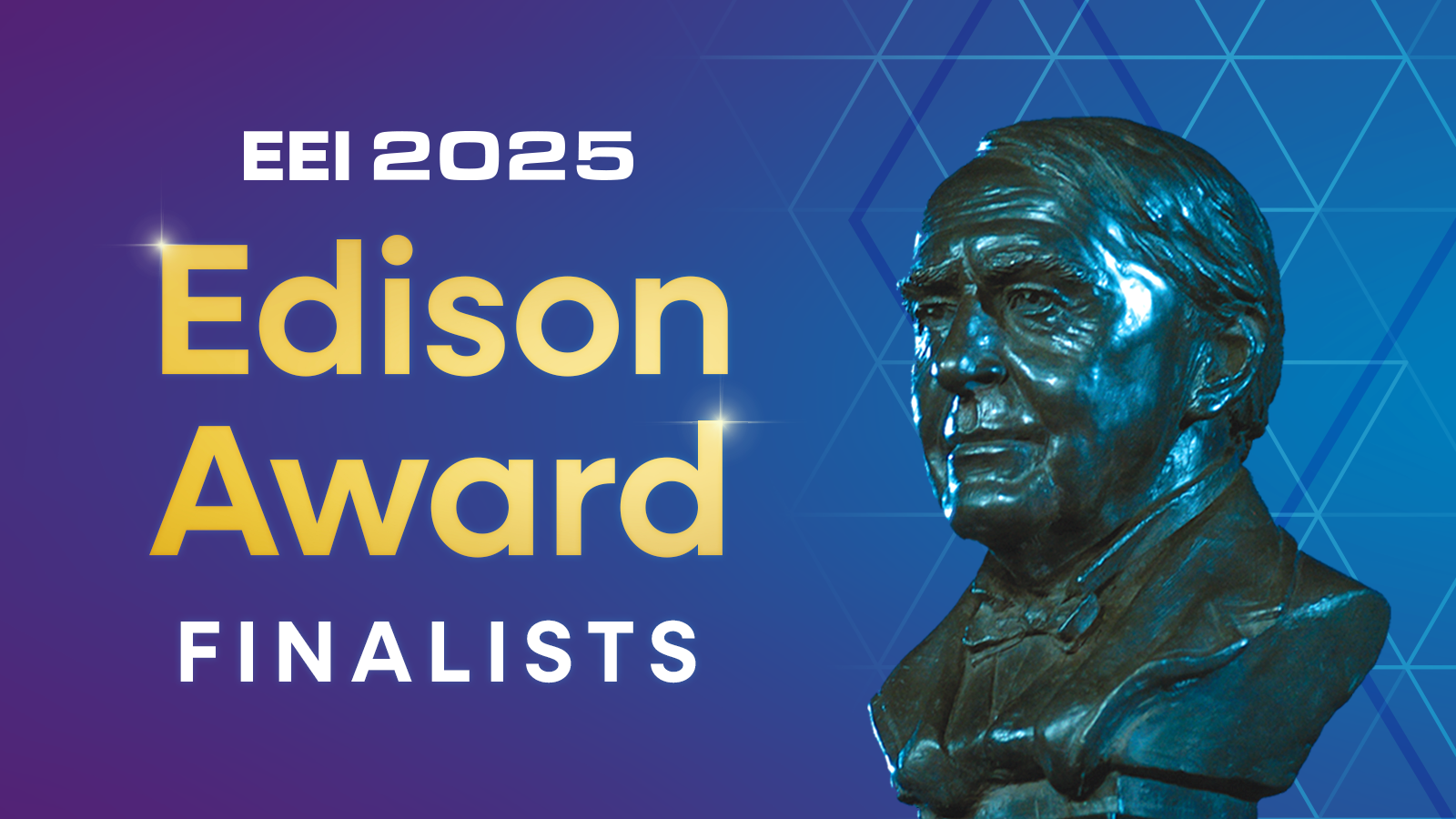
Since 1922, the Edison Award has recognized electric companies for their distinguished leadership, innovation, and contribution to the advancement of the electric industry for the benefit of all. The Edison Award is the most prestigious honor.
In March, an independent panel of reviewers met to evaluate nominations for the 2025 Edison Award and selected projects from The AES Corporation, Duke Energy, Edison International and Southern California Edison (SCE), and Southern Company as domestic finalists. Projects from ATCO Electric and Fortis Inc. were selected as international finalists.
“EEI’s member electric companies continue to drive innovation across their companies by investing in and deploying cutting-edge technologies and solutions that benefit the customers and communities they serve,” said EEI interim President and CEO Pat Vincent-Collawn. “This year’s Edison Award finalists have demonstrated exceptional leadership and ingenuity, and this recognition is well-deserved.”
The winners of the 97th Edison Award will be selected by a panel of former electric company chief executives and will be announced during EEI 2025, EEI’s annual conference and thought leadership forum, to be held June 2-4 in New Orleans.
Learn more about the Edison Award at eei.org/awards.
Domestic Finalists
The AES Corporation
- Maximo, the AI-Powered Robot
The AES Corporation unveiled Maximo, a first-of-its-kind robot powered by artificial intelligence (AI) and built to install solar panels quickly, precisely, and efficiently, in 2024. The robot works alongside construction crews to automate heavy lifting and precise placement tasks associated with installing solar panels, ultimately making the installation process safer and reducing costs.
Maximo is on track to install more than 100 megawatts of solar panels in 2025 and is slated to be deployed across 5 gigawatts (GW) of projects during the next three years, including the 2 GW Bellefield solar project in Kern County, Cali. That project, under contract with Amazon, is the largest solar-plus-storage project to be permitted in the United States to date.
Using advanced sensors and cameras, an industrial robotic arm, and generative AI to refine exact coordinates and dimensions for placement, Maximo can install solar panels in half the time and at half the cost of traditional crews while also opening the door for new career opportunities. Already, AES crew members have continued to work onsite alongside Maximo when they otherwise would have been sidelined from installation due to unpredictable weather conditions or staff shortages.
Duke Energy
- Setting a New Bar for Climate Resilience and Storm Response
In 2024, Duke Energy advanced its science-based planning to enhance grid resilience and reliability in the face of extreme weather. The company published the first comprehensive assessment of climate risks across generation, transmission, and distribution for a vertically integrated electric company: the Duke Energy Climate Resilience and Adaptation Study.
Hurricanes Debby, Helene, and Milton impacted customers in all six states served by Duke Energy, leaving catastrophic damage in their wake and demanding a historic coordinated response from across the electric power industry. Duke Energy mobilized more than 20,000 workers in response to Helene and nearly 19,000 following Milton, and Duke Energy Foundation provided more than $2.3 million in grants to 78 organizations for disaster relief and recovery.
Resilience and restoration efforts were aided by the $4 billion Duke Energy invested last year in hardening and modernizing the grid, which included undergrounding lines, upgrading poles to steel and concrete in coastal areas, and installing innovative self-healing grid technology. These investments helped to avoid nearly 550,000 customer outages and saved 7 million hours of total outage time during Debby, Helene, and Milton.
These real-world challenges tested and validated the importance of Duke Energy’s commitment to resilience and system adaptation, solidifying the need for the industry to continue collaborating to further prepare for extreme weather events. Duke Energy is investing $70 billion during the next decade to make the grid smarter, stronger, and more resilient. The resilience and adaptation study also identified future opportunities, like new infrastructure design standards, to accommodate higher temperatures and mitigate impacts from flooding.
Edison International and Southern California Edison (SCE)
- AWARE System
SCE’s Advanced Waveform Anomaly Recognition (AWARE) system supplements advanced sensors and other applications already used by many electric companies with state-of-the-art physics-based AI models and machine learning technologies. The resulting grid anomaly detection and proactive fault management technology can help to identify and locate problematic equipment on SCE’s circuits before a failure occurs, mitigating outages and helping to keep customers and communities safe and energized.
Many smart grid technologies use electric waveforms to detect faults, but the energy grid’s increasing complexity and the rise of customer-sited distributed energy resources can add noise that is difficult for traditional detection programs to sift through.
SCE’s AWARE system uses AI and machine learning to identify the unique waveforms for different kinds of equipment failures. It also can help to pinpoint where failures take place within SCE’s service territory, accelerating restoration times and supporting safer and more targeted restoration efforts.
Southern Company
- Plant Vogtle Unit 4
Plant Vogtle Unit 4 entered commercial operation in April 2024, following the completion of Vogtle Unit 3 the year prior. Each unit can power 500,000 Georgia homes and businesses and will serve communities across the state for decades to come. Collectively, the units have created 800 new good-paying, high-quality permanent jobs while helping to strengthen America’s nuclear energy supply chain and talent pipeline.
Sitting on 3,000 acres of land on the banks of the Savannah River, Plant Vogtle is the largest generator of carbon-free nuclear energy in the United States, capable of producing more than 30 million megawatt-hours of electricity annually.
The nuclear energy produced by Vogtle Units 3 and 4 will prevent an estimated 10 million metric tons of carbon dioxide emissions annually, equivalent to planting 165 million trees every year, all while powering Georgia’s economy.

International Finalists
ATCO Electric
- Jasper National Park Wildfire Response
The 2024 wildfire in Jasper National Park was one of the most devastating in Canadian history, destroying nearly a third of the town of Jasper and forcing 25,000 residents to evacuate. Despite extensive damage to more than 800 electric and natural gas assets, ATCO Electric restored power to all properties able to receive it within 16 days of the fire’s outbreak—preventing economic losses while supporting community livelihoods.
The Jasper fire was first reported on July 22, 2024, and spread quickly and aggressively. ATCO Electric employees were among the last to evacuate and first to return as they worked to restore power to impacted communities. Through ATCO Electric’s extensive experience with wildfires in Alberta, the company effectively collaborated with Parks Canada and the Municipality of Jasper to rebuild infrastructure safely and as quickly as possible.
Grid hardening was critical to ATCO Electric’s response and restoration efforts. ATCO Electric undergrounded nearly 8 kilometers (5 miles) of distribution lines near a popular ski hill, replaced cables and converted lines associated with a local sky tram, and installed non-combustible composite poles to protect against future fire risk—highlighting the company’s commitment to supporting the area’s key economic driver and source of jobs.
Fortis Inc.
- Wataynikaneyap Power Transmission System
The approximately $1.9-billion Wataynikaneyap Power Transmission System is Canada’s largest Indigenous-led electricity project. Fortis partnered with Wataynikaneyap Power and 24 First Nations communities to construct the 1,800-kilometer (1,118-mile) transmission line connected to 22 substations. The system connects 17 rural and remote First Nations communities to the Ontario provincial energy grid.
Construction of the system began in 2020 and was completed in May 2024. With 16 of the 22 substations and half of the transmission line accessible only during winter months, construction timelines needed to be compressed, meaning, in some cases, a year’s worth of work needed to be completed in a matter of months.
The new transmission system is expected to reduce carbon emissions by 6.6 million tonnes during the next 40 years and will reduce First Nations communities’ reliance on diesel generation. Construction on new homes, offices, health facilities, fitness centers, and schools has already begun in areas that previously were unable to expand due to lack of access to reliable, affordable energy—underscoring the industry’s critical work to drive communities forward.