
Focused on the Future: Powering Progress With Resilient Clean Energy
Ralph LaRossa, chair, president, and CEO of Newark, N.J.-based Public Service Enterprise Group (PSEG), has worked for decades to help make PSEG's and EEI's shared vision for a resilient clean energy future a reality. LaRossa joined PSEG subsidiary Public Service Electric and Gas Company (PSE&G) in 1985 as an associate engineer. He was named president and COO of PSE&G in 2006, became president and CEO of PSEG in September 2022, and he was named PSEG board chair earlier this year.
LaRossa recently sat down with Electric Perspectives to reflect on his first year at the helm of New Jersey's oldest and largest investor-owned electric company-and the lessons he has learned during his career.
Electric Perspectives (EP): You were named PSEG president and CEO last year, and you became chair of the PSEG board earlier this year. What can you tell us about the past several months and the team you have in place around you?
Ralph LaRossa (RL): Even though I just passed my one-year mark as CEO, I am proud to say that I have been with PSEG for 38 years. I am thankful to be part of this company, and I am thrilled to be a part of an industry that touches so many people's lives every day. We supply natural gas to 1.9 million people in New Jersey; electricity to 2.3 million people; and we manage the Long Island Power Authority's electric system on their behalf, reaching another 1.1 million customers in New York.
I do not take my role as CEO lightly. I view the past 12 months as a tremendous opportunity, and I hope that our employees have seen that our senior leadership team is laser-focused on supporting the strength of this company and building toward the future. Our team members are incredible partners in this journey, and I value their expertise and diverse opinions.
We all are focused on doing what is right for our employees and our cus tomers in New Jersey and on Long Island. We couldn't do what we do without the hard work and support from the 12,500 PSEG employees who roll up their sleeves every day to keep the lights, heat, and power on for the customers and communities we serve.
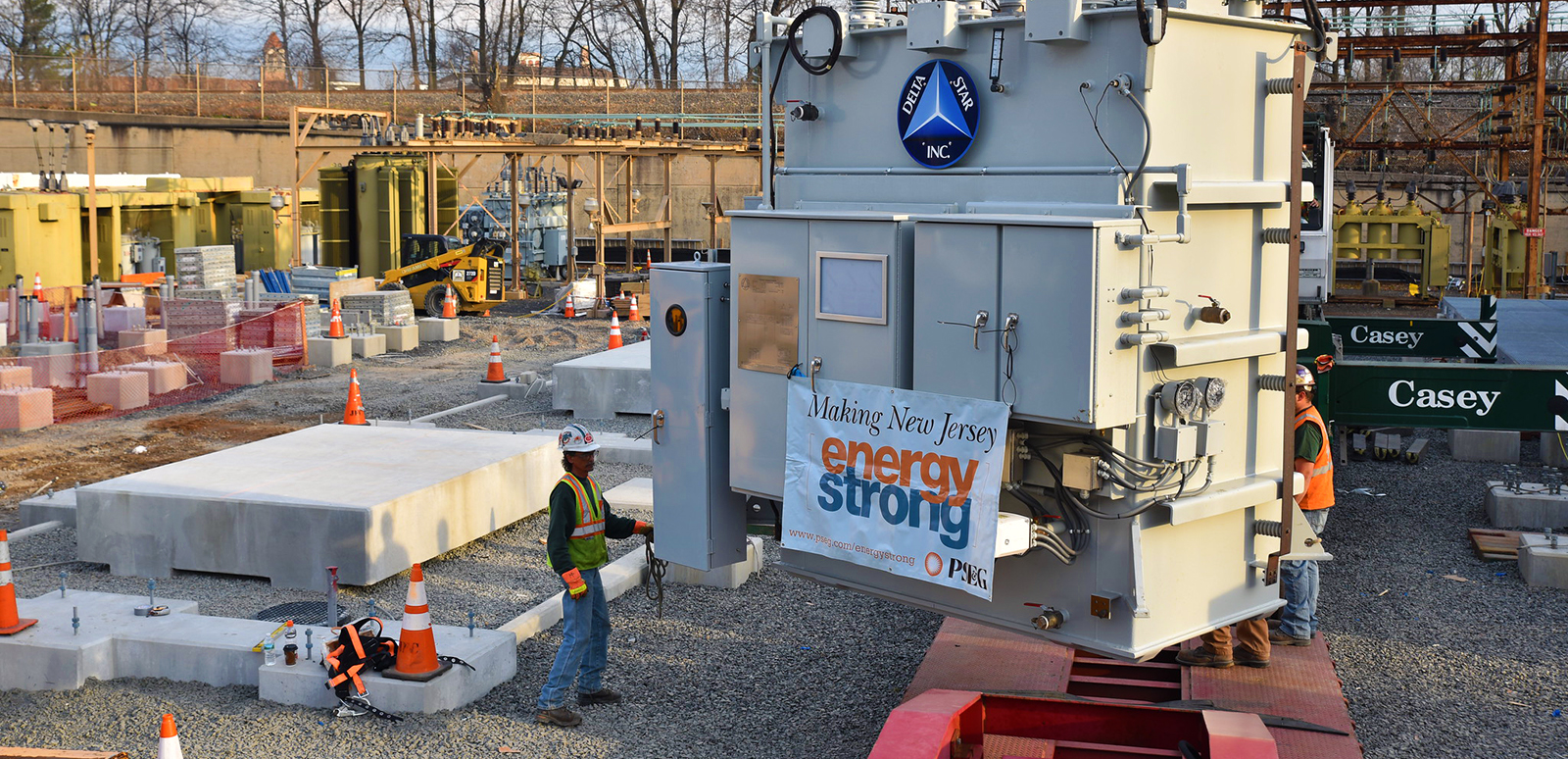
LaRossa has helped lead significant investments to modernize infrastructure and enhance reliability and resilience.
EP: What is your proudest accomplishment in your more than 30 years in leadership roles at PSEG?
RL: I'm not sure there is one single thing I can point to over the years that defines my time at PSEG, because there are so many accomplishments that this team has achieved and can take pride in.
I remember small things, like when I was starting out as an engineer and received a call on Christmas Eve to make a decision about a major gas leak in a retail establishment. That really impacted me personally, as I quickly realized that the decisions that we make can meaningfully impact the lives of those we serve.
I still vividly remember how the entire company came together during Superstorm Sandy in 2012, working around the clock to restore power safely and quickly. Looking back, I am still proud of our team's commitment to doing right by our customers during such a chaotic, dangerous, and uncertain time.
Providing that comfort to our customers is something I learned after the terror attacks on September 11, 2001, when we sent our PSE&G crews into the field to work a "normal day," so that our customers would see us and understand our commitment to serving them.
EP: PSEG this year celebrated its 120th anniversary. How is the work that you are doing today setting the stage for success as PSEG serves its customers and communities in the next 120 years and beyond?
RL: Predictability and reliability have always been priorities of ours, and we plan on being around for the next 120 years. For us, that means taking smart steps with the financial strength of our company in mind. It also means working with policy makers to help them understand the goals and priorities of our company and our industry while prioritizing what our customers care about most: safety, affordability, and reliability.
One of the most important com munities that our company serves is our workforce. We are focused on transforming our safety culture to ensure that our employees feel safe and secure when they come to work every day. We are engaged at every level, particularly with our frontline workers, who may put their personal safety at risk to serve their communities. I credit much of our company's success to our strong commitment to our workers, including strong labor relations that are grounded in mutual respect.
EP: PSEG is planning to make significant investments as it continues to modernize its critical energy infrastructure. Can you speak to the significance of these investments and the areas where the company is focusing?
RL: Even though our company is 120 years old, we come to work every day focused on the future. Last year, we unveiled our Powering Progress vision for a future where people more efficiently use energy that is cleaner, safer, and delivered more reliably than ever. We consider that vision to be our North Star, and we are doing what we can to make it a reality. That includes making investments in things like energy efficiency initiatives and electric vehicle (EV) charging infrastructure that will help meet current EV needs and prepare us for the wave of EV demand that will come in the years ahead.
It also means modernizing our gas system to enhance safety, mitigate methane leaks, and reduce greenhouse gas emissions. We also are building out and strengthening our last-mile service connections to individual neighborhoods, streets, and houses. We have seen, especially since the onset of the pandemic, how critical electricity is to our modern lifestyle.
We also are supportive of New Jersey's goal to reach 100-percent clean energy by 2035. We know that, as New Jersey's largest electric and natural gas company, we will play a significant role in getting the state over the finish line. As we work to support these goals, we also plan to advocate for cleaner power generation. We hope to see PJM Interconnection, the regional trans mission operator that oversees New Jersey and 12 other states, take steps to ensure that, as states electrify, the energy necessary to meet customer demand does not come from carbon intensive generation.
“Even though our company is 120 years old, we come to work every day focused on the future.”
EP: You mentioned Superstorm Sandy. You were President and COO of PSE&G in 2012, and you helped lead the storm response and recovery efforts. What did you learn from that experience, and how has it shaped your views on extreme weather events and storm response in the years since?
RL: Superstorm Sandy taught all of us just how vulnerable we are to the impacts of climate change. After facing unprecedented, widespread outages in our region, we knew that we needed to take mitigation steps so that our service territory would never again be so heavily impacted. In the decade-plus that has followed, we have undertaken significant improvement initiatives to strengthen our critical infrastructure and reduce or eliminate some of the vulnerabilities that the storm laid bare. Among other efforts, we have raised or hardened 64 of our substations. We saw the benefits of those investments firsthand when Hurricane Ida hit in 2021. Our customers were minimally impacted by outages, and we have even more substation upgrades planned in the years ahead so that our system can be more resilient than ever.
Unfortunately, we know that climate change isn't going away and that storms will continue to grow infrequency and severity. As people simultaneously become more dependent on electricity to power their everyday lives, we need to make investments to ensure the grid is ready and resilient to the impacts of extreme weather. Our last-mile work also will come into play here, since those improvements will bolster reli ability at the neighborhood and street level, making the energy that we pro vide more reliable and increasing grid capacity for our customers.
EP: What is your perspective on the importance of maintaining a balanced energy mix that utilizes all of the tools that we have in our clean energy toolbox, including natural gas?
RL: So much of the current energy discussion focuses on electrification, and that is an important part of our future. But, it is not the whole picture. Natural gas is an important piece of the puzzle as we work toward a resilient clean energy future. This is especially true if you consider the amount of electricity on our grid that comes from car bon-intensive fossil generation. We must advocate for cleaner power generation so that we don't end up electrifying more homes and work places with energy that isn't getting cleaner.
We also know that investing in our natural gas delivery system can reduce emissions. In fact, upgrades to our gas distribution system from 2011 to 2022 reduced approximately 300,000 metric tons of carbon dioxide equivalent, which is the equivalent of removing 65,000 cars from the road. These kinds of improvements are significant when you consider that fossil fuels still make up approximately 60 percent of the generation on the PJM grid.
Replacing old pipes is an effective way to lower emissions now and pre pare to deliver low-carbon fuels like hydrogen and renewable natural gas, which we have proposed introducing into our system.
EP: Throughout your career, who have you looked to for advice and inspiration? Who have been your role models?
RL: On a personal level, my role models have always been my parents. My dad is an immigrant, and my mom was a woman trying to enter the workforce in the 1950s, when she faced significantly more barriers than she would today. What I learned from watching them each and every day has paid dividends throughout my career.
I also have learned so much from those with whom I have worked. Bosses like Ralph Izzo have certainly influenced me, but several union leaders and workers have as well. I have been blessed to work for a company full of effective and committed leaders.
EP: What is your philosophy for developing the next generation of leaders in our industry?
RL: As one of our core company commitments, we work to incorporate diversity and inclusion efforts into our operations so that our employees have the tools, resources, and support that they need to deliver safe and reliable energy to our customers. This work starts with recruitment. For example, we are working to break down barriers to employment by carefully reviewing job descriptions and eliminating any unnecessary job requirements. We also are building innovative programs to increase representation of employees from diverse backgrounds, including our Pre-Apprentice Readiness Program, which we anticipate will broadly expand our applicant pool by creating new, entry-level, skilled-trades positions.
I also am proud of our Clean Energy Jobs Program. It is a training and employment collaboration involving PSE&G, the New Jersey Department of Labor and Work force Development, and more than 40 public, private, and community organizations. The program was designed to help generate economic opportunities for more than 2,000 unemployed or under-employed New Jersey residents from low- and middle-income households. I am delighted that we not only have met but exceeded our initial goals for the program. We remain focused on developing the next generation of clean energy workers while advancing sustainability, equity, and economic growth. The success of this program is a testament to its triple-win impact: It benefits the workforce, the great state of New Jersey, and PSEG.
Superstorm Sandy impacted my workforce development philosophy, and I carry the lessons I learned from that event with me today. It rein forced that we need to empower our employees to delegate decision making and problem solving across our organization. That kind of employee empowerment lets workers know we trust them, and it allows them to act quickly and decisively-which is especially important during extreme weather events.