
The Clean Energy Future: Urgency Is Key
EEI Chair Pedro J. Pizarro, president and CEO of Edison International, describes the pursuit of a clean energy future as a marathon, not a sprint. The inclusion of critical clean energy provisions in the Bipartisan Infrastructure Law and the Inflation Reduction Act, and the siting and permitting provisions in the Fiscal Responsibility Act, have helped the electric power industry pick up the pace in pursuit of clean energy goals. Still, as he looks out at 2024 and beyond, Pizarro believes that now is the time for action that will accelerate the industry's efforts even further. EP recently spoke with Pizarro to discuss his perspective on policy priorities, security and resilience initiatives, and the path toward a clean energy future.
Electric Perspectives (EP): The pace of change in the electric power sector seems to be faster than ever before. What have you observed during your first six months as EEI chair?
Pedro J. Pizarro (PJP): First, it’s been a privilege to serve on the EEI Board of Directors’ Executive Committee for the past six years and an honor to be selected as chair of EEI. Our industry’s collaborative spirit is a model for other sectors—and is a major benefit to electric customers around the country. Reducing carbon emissions 36 percent below 2005 levels is no small feat, and EEI members did that safely, affordably, and reliably while navigating increasing climate impacts and unprecedented growth in the use of electricity.
That cooperation and collaboration extends to how our members respond in times of need. They support each other through mutual assistance, with a collective commitment to physical safety and cybersecurity all while stepping up to advance our industry’s goals. I was proud to lead the EEI delegation at COP28 in Dubai and share these same messages. At every opportunity, I reminded people that the electric power industry is at the center of the clean energy transformation. We provide an essential service and have done more than any other industry to reduce carbon emissions in the United States. However, now is the time for action. We simply cannot wait to make the investments necessary to mitigate and adapt to the effects of climate change. We must continue to work together to educate policymakers and other key stakeholders about the roles that we all must play in evaluating and approving prudent investments in grid resilience. With what we know today about energy needs and potential threats to critical energy infrastructure, proactive investments can be made that will greatly drive down risk and could even help to save lives.
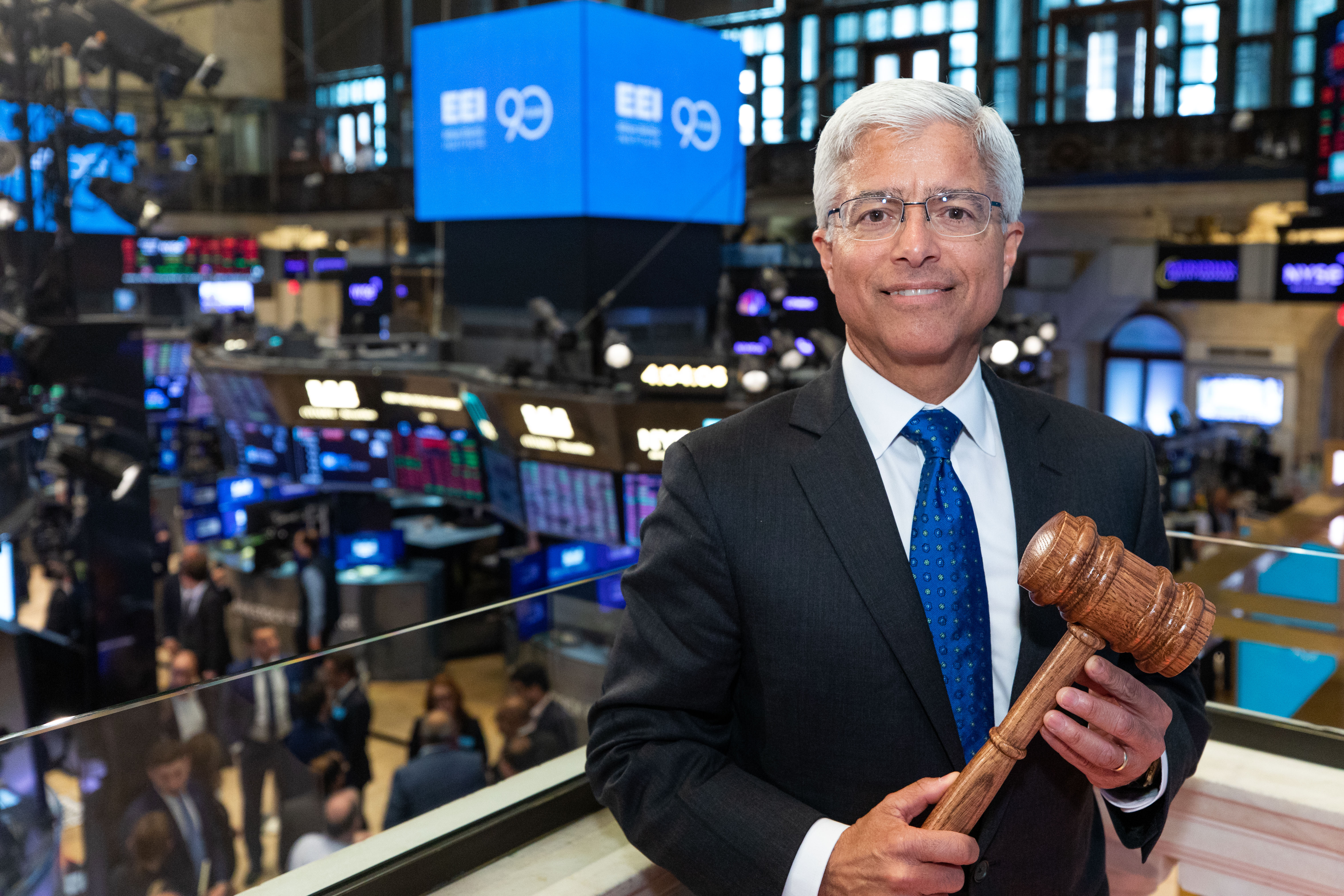
EEI Chair Pedro J. Pizarro, president and CEO of Edison International, attends EEI's annual Wall Street Briefing.
EP: EEI and our member companies were strong supporters of the Bipartisan Infrastructure Law and the Inflation Reduction Act, which are driving meaningful investments in our sector. What do you see as the next key policy priorities for our industry?
PJP: The clean energy future is a marathon, not a sprint, and runners know when it’s time to pick up the pace. Legislation that will accelerate our clean energy future is a priority. It has been rewarding to see EEI’s work result in favorable policies within the Bipartisan Infrastructure Law and Inflation Reduction Act. Now, we must continue to focus on implementation. These wins need to translate into getting steel into the ground and real benefits for our customers.
Reforming the transmission siting and permitting process is high on the priority list. Even with the provisions included in the Fiscal Responsibility Act, it’s one of the major headwinds we face in building out the massive amount of new infrastructure our country needs.
Edison International’s recent analysis of the state of California, Countdown to 2045, anticipates that electricity demand will skyrocket by more than 80 percent by 2045. To accommodate that growth, the state will need to add transmission at four times and distribution at 10 times historical rates. Colleagues from other states and countries tell me they have similar expectations in their areas. Our energy grid must expand like never before.
We also need legislation to address the financial risk that comes with climate change impacts like extreme storms and catastrophic wild res. is uncertainty around liability creates unknown and unpredictable risks for the electric companies that play a vital role in growing the economy and delivering affordable and resilient clean energy across our economy. Left unaddressed, this liability will constrain critical investments in new clean energy resources and the resilient infrastructure needed to deliver it to customers.
The escalating threats to our grid security represent another area where we need close collaboration with the federal government. Notable policy priorities include congressional authorization of the new Energy Threat Analysis Center, an important venue where industry operators and government partners will help identify threats and share mitigation strategies across the industry. Additionally, we need liability protections to eliminate barriers to information collection and sharing between industry and government. We must address any tension we see between our fiduciary obligations and our role as critical infrastructure providers supporting national security.
“The clean energy future is a marathon, not a sprint, and runners know when it's time to pick up the pace.”
EP: Can you speak to the central role our industry plays in serving customers, particularly as the economy continues to electrify?
PJP: Our ultimate responsibility is to safely provide reliable and clean electricity to our customers at an affordable cost. That is what we must do—period.
Investor‐owned electric companies can build and maintain the energy grid quickly and at a lower cost to customers than any other model. We have an obligation to serve all customers in all communities and to provide programs that support affordability. That includes solar energy and energy storage installation, energy efficiency, demand response, and time-of-use programs. Customers also need clear communication from their electricity providers, which is why electric companies are working to provide timely information in a variety of ways that can be tailored to the preferences of each customer. This helps to ensure that customers are getting the information they need, when they need it, in the ways they prefer.
We’re seeing more customers electrifying their cars and homes. There also is a large number who can’t yet afford electric technologies. Getting all pieces of that right is more important than ever. Electric companies recognize our responsibility to be trusted advisors—educating customers on new products and technologies and helping them understand new opportunities to save energy and lower their bills.
EP: In addition to your role as EEI Chair, you serve as a co-chair of the Electricity Subsector Coordinating Council (ESCC), which facilitates coordination between the highest levels of industry and the federal government to prepare for and respond to national-level disasters and threats to critical infrastructure. Can you speak to the value of this partnership, and the progress that has been made together?
PJP: Forums like the ESCC are a great way for us to pool our experience and reach better decisions and outcomes. We’ve made progress in a few key areas.
Mutual assistance is one. The electric power industry has been effective at coming together in times of crisis. Over the past decade, we’ve applied that commitment to expanding mutual assistance programs to manage cyber incidents and to secure our supply chain.
The ESCC enables the electric power industry to work effectively with government partners in responding to threats to critical energy infrastructure. That’s vital when real-time coordination makes a difference. In recent years, we have effectively coordinated support with the White House, the U.S. Department of Energy and various government agencies, and federal law enforcement in responding to challenges like COVID-19, extreme weather events, and high-impact physical attacks on the grid.
Another key area is shared forecasting. ESCC members bring their company’s unique vantage points to industrywide discussions about threats and hazards. This can include perspectives from varied geographic regions, different business models, and individual grid architectures. We exchange information and assessments to create a better shared understanding of the threats and risks we face.
Our federal partners bring powerful intelligence gathering capabilities to the table, and, together, we can evaluate today’s risks and deliver actionable intelligence and guidance to the experts who operate the energy grid.
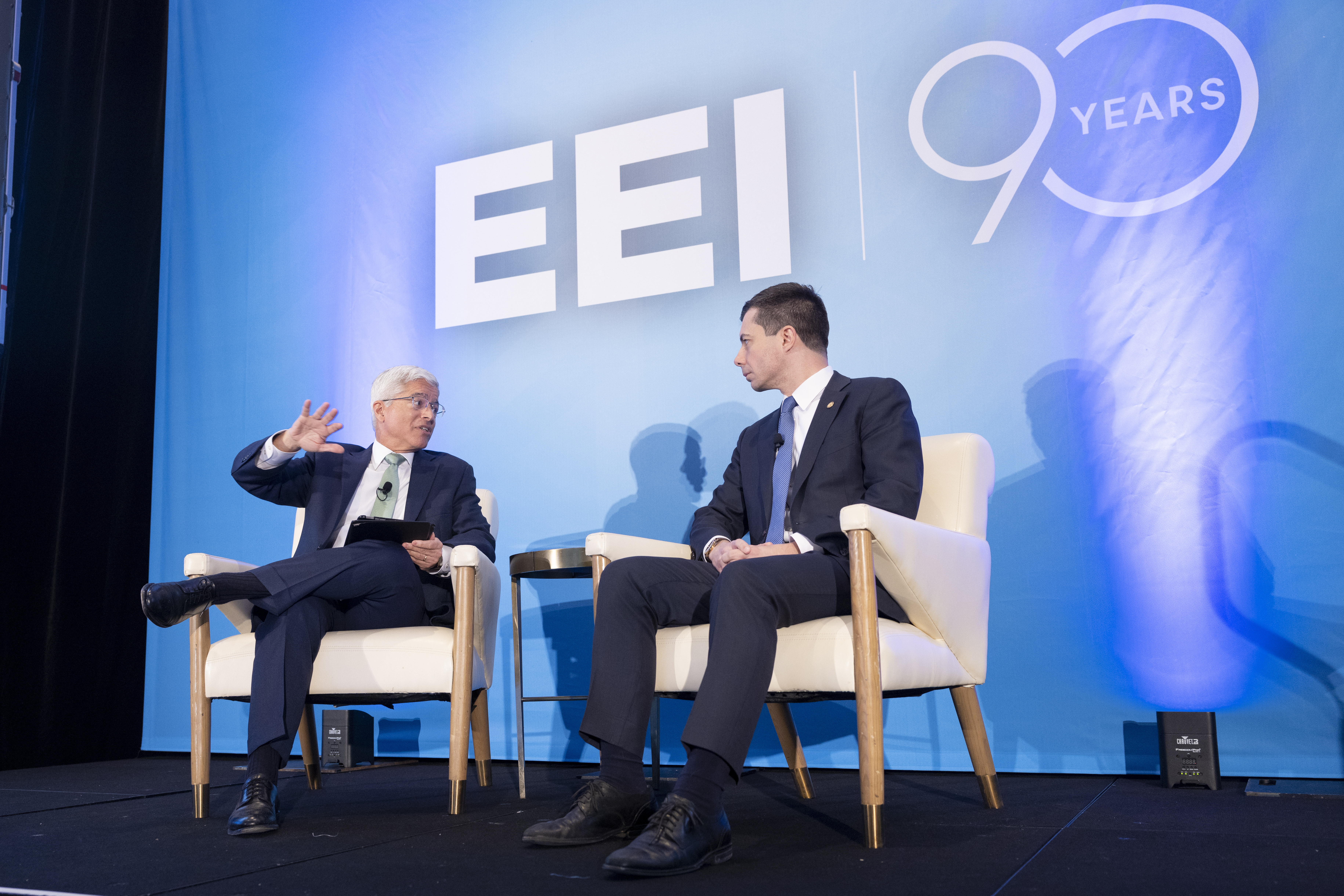
Pizarro discusses transportation electrification with U.S. Department of Transportation Secretary Pete Buttigieg.
EP: You have often spoken about the need for our industry to remain focused on scaling up physical and cybersecurity defenses. How have you seen our industry’s focus on protecting critical energy infrastructure evolve during your career?
PJP: The electric power industry is committed to security and resilience, while also understanding our responsibility to maintain affordability. Those longtime priorities, which are sometimes competing, have led us to a thoughtful, risk-based approach to defense. We track threats, apply the best-suited mitigations, and avoid chasing one-size- fits-all solutions.
Our risk-based approach to protecting infrastructure has allowed our industry to evolve as the grid and the threats change around us. Every day, industry security teams work to identify and adapt to the changes we are seeing anything from more dangerous malware to more powerful rearms. The teams also are looking at changes to the grid itself, especially as more renewables and distributed energy sources on the grid expand the attack surface. There’s some good news with new technologies and tools in the market that can help us protect our infrastructure.
With rising geopolitical concerns from the wars in Ukraine and the Middle East to rising tensions with China it is more important than ever that we continue to refine our existing security strategies while adding new tools to the toolbox.
“The electric power industry is committed to security and resilience, while also understanding our responsibility to maintain affordability.”
EP: Can you discuss the significance of diversity, equity, and inclusion (DEI) initiatives to moving our industry forward?
PJP: I’m proud that DEI has become a universal part of our business. EEI launched an industrywide DEI initiative in 2020 that focused on diversifying our workforce at all levels, and 100 percent of member companies participated. EEI also has supported the Biden administration’s Justice40 Initiative, which is another way we are making sure that the investments being made in clean energy, electric transportation, and resilience are benefitting underserved communities.
At Edison International, I see every day how diversity makes us stronger. In 2022, we achieved gender parity among our independent board directors, and, in 2021, we reached gender parity among my direct team of senior leaders.
Our diversity initiatives include suppliers. It’s important to support our local businesses and communities, and having a diverse supplier base also helps increase collaboration with community-based organizations. They are a valuable source of feedback from underserved communities and provide better education and awareness on important topics.
We also have workforce development e orts to add more diverse talent, including our Edison Scholars and Lineworker Scholarship programs. e Edison Scholars Program awards $50,000 in shareholerfunded academic scholarships to 30 high school seniors each year to study science, technology, engineering, or math in college. Our Edison International Lineworker Scholarship program welcomed a third cohort of 12 scholars in 2023, including our second female scholar. The program awards scholarships up to $25,000 and is funded by Edison International shareholders and IBEW Local 47.
We can’t do this in a vacuum. Being transparent and providing data are essential to building trust. We hold ourselves accountable by setting goals and reporting outcomes annually in our Sustainability, DEI, Community and Economic Impact and Supplier Diversity reports.
There are many other great examples of DEI programs and initiatives throughout the industry. What is clear is our shared commitment to developing the workforce that we need to deliver a resilient clean energy future.

Through the Edison Scholars Program, Edison International awards $50,000 scholarships to 30 high school students each year who plan to study science, technology, engineering, or math in college.
EP: How can the industry attract and retain workers with diverse skillsets and backgrounds to power the clean energy future?
PJP: This is an exciting time to be part of the electric power industry, and I encourage young people to be a part of the clean energy future. The electric power industry is rooted in a strong sense of mission: We account for around 5 percent of the U.S. economy, and we reliably and affordably power every other industry. Over time, our mission has expanded to leading efforts to drive down carbon emissions across the U.S. economy. We will need new technologies, new processes, and new laws and regulations. Most important, new bright minds must join our ranks. There is tremendous opportunity ahead.
I recommend that young people learn as much about the industry as they can. Talk to everyone: people in transmission and distribution, planners, engineers, lineworkers, customer service representatives, public affairs experts, and information technology specialists. Read articles to see how the media is covering the industry. Follow industry leaders and companies on social media. No matter the role, having a well-rounded understanding will help you go far.
Invest in yourself, guided by feedback from those around you. Our companies operate strong electric networks by nurturing strong human networks. Connect with the network around you, contribute to it, and seek input from it. Set personal goals by identifying senior roles that you aspire to reach in 5-10 years. Get feedback on what two or three skills you would need to build to be a good candidate for those roles, and work hard to develop them. Your career journey may or may not end up in those specific senior roles, but the act of investing in your development will prepare you for the opportunities that do come your way.
Finally, aim to serve. Our industry is committed to serving serving our customers, supporting our communities, partnering with government leaders, and helping one another through our strong tradition of mutual assistance. As you progress as an energy professional and leader, you will find that more of your role is about helping your team succeed than about helping yourself. Your success will be defined by your team’s success, just as our industry’s success is defined by our collective ability to provide reliable, resilient, and affordable clean energy to our customers and communities that depend on us more than ever before.